
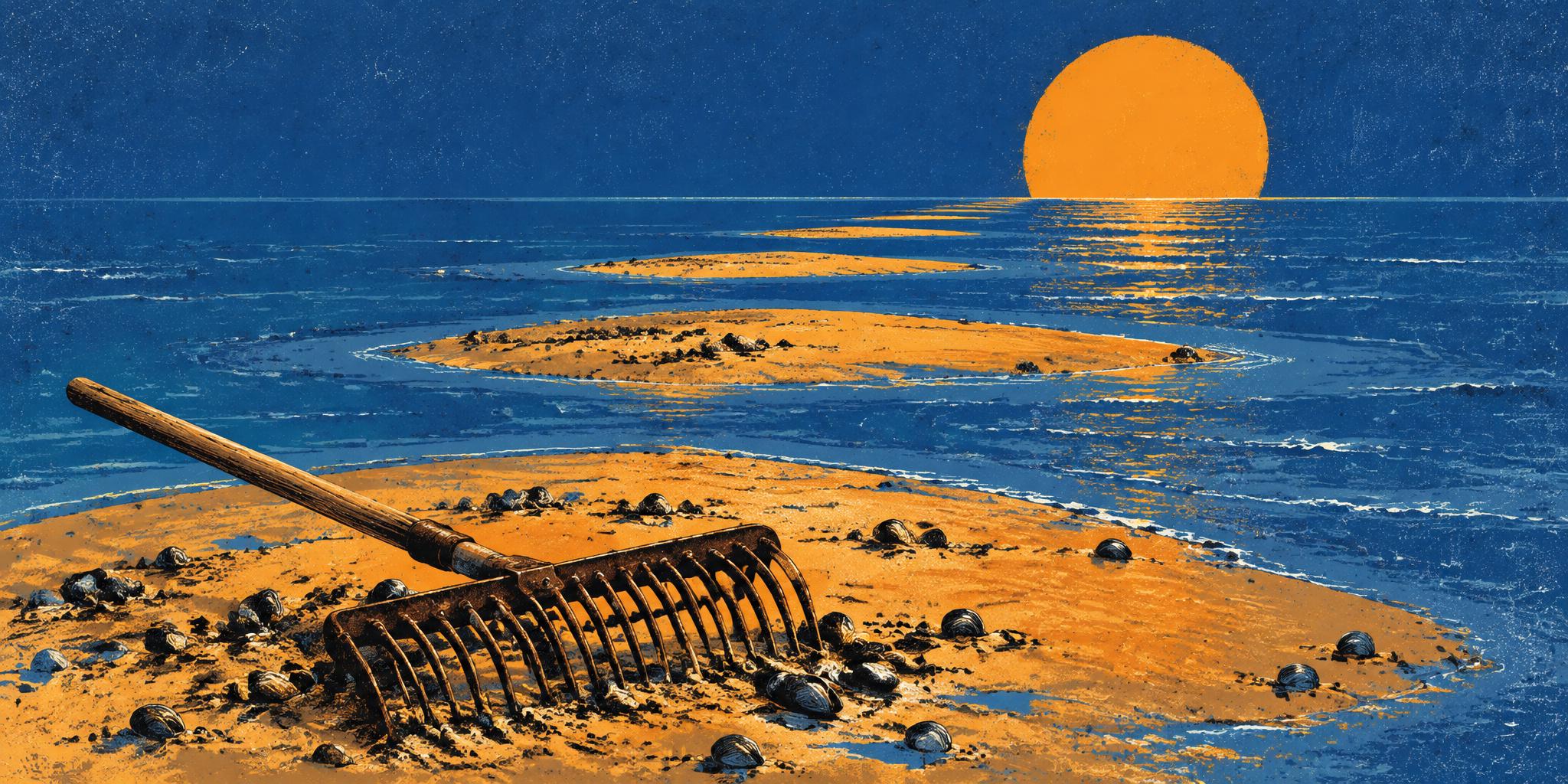
In November 1974, shellfish growers and their allies talked the Netherlands out of a flood dam that was already half built. They kept most of the tide they were fighting for. Fifty-two years later, the country is still paying to keep it working.
In 1973, every farmed mussel and oyster the Dutch trade landed, from every bay and inlet in the country plus a few spots abroad, was worth about ƒ26 million. (The ƒ is for guilders, what the Dutch spent before the euro.) Three years later, government engineers put a price on saving one of those inlets. A storm barrier across it, along with the smaller dams the barrier needed, would cost about ƒ2.6 billion more than finishing the dam already half built there. The extra alone came to about a hundred times that year's harvest. Knock off a few years of inflation between the two figures and it's still many decades of the national catch.
Line those numbers up and you'd figure some minister lost his head over a plate of shellfish. He didn't, though the shellfish people were out front in the fight. A country stopped a flood-protection project with more than half of it already standing in the water and built something else at far greater cost. Then it spent the next forty years finding out that the thing it had saved would need tending indefinitely.
A plan nobody could call foolish
In February 1953, a North Sea storm pushed the sea through the dikes of the southwest Netherlands and drowned whole villages in one night. The government answered with the Delta Plan. It would put dams across the arms of the sea that reach inland down there, shortening the coastline so the next storm would have fewer miles of dike to break.
One of the biggest of those arms is the Oosterschelde, a wide tidal inlet in the province of Zeeland. The plan was to close it for good. Behind the dam, the salt water would slowly go fresh, and the country would end up with a lake that could water farms and supply drinking water. If you'd ever lain awake through a winter gale thinking about the dike at the end of your road, you wouldn't have found much there to argue with.
By the end of 1973, about five of the planned nine kilometers of dam were in, roughly three of five and a half miles. Artificial islands had been built up out of the water and stitched together with dam sections. Three deep channels still let the sea in and out. Over them stood twelve tall towers, waiting to carry cables strung across the water like a ski lift. The cables would run concrete blocks out over the channels, and the blocks would go down one after another until there were no channels left. A government with twelve towers standing in the water is not, as a rule, in the market for alternatives.
The people who farm the tide
On the south shore of the inlet is Yerseke, a town that had lived off shellfish for generations. Growers there rent patches of the seabed. A mussel grower spreads young mussels over his patch and leaves them a year or two while the tide comes in twice a day with the plankton they eat. Then he dredges up the crop. He brings the boat, the labor and the knowledge of what's on the bottom. The sea brings the feed, every day, free of charge.
A freshwater lake would finish all that. Mussels and oysters can't live in fresh water, so the trade would just stop.
In July 1973, the oyster growers' association and the fisheries association threw in with a study group and a local action group to form the Comité Samenwerking Oosterschelde. Everybody called it Comité SOS, and no fisherman needed the initials explained. Anglers, sailors and water-sports clubs came aboard, and later the environmental organizations, the World Wildlife Fund among them. Most of what's known about the inside of that coalition comes from an archival study of Yerseke's resistance by Erleyne Brookman. In the records that survive, the men who actually worked the plots show up mostly through the leaders of their associations, which is how working people generally get into the history books.
The fisheries chairman, A. L. S. Lockefeer, told the regional paper that keeping the inlet open was a matter of self-preservation for the industry. He was also a careful man. In late February 1974, with the commission's report about to come down, Lockefeer wrote to the action group and asked it to hold off commenting on the report. He was worried about polarization, about the fight setting hard into two camps. When your members' living depends on a negotiation, you have to think about the morning after, in a way an action group doesn't. Both wanted the sea arm open; the letter shows they didn't agree on everything else.
The coalition had more to offer than a demand to stop. In 1972, students from four Dutch universities had proposed a different structure: a barrier with gates that would stand open in ordinary weather and let the tide through, then close when a storm pushed the sea up. Whether anybody could actually build such a thing across those channels, at a price the country would stand for, was another matter.
The people who wanted the blocks dropped
Across the water, on the island of Tholen, people weren't inclined to wait around while that got answered.
Tholen's municipal council voted 15 to 2 to finish the original dam. Local leaders boiled their position down to three words: niet langer dralen, no more dithering. The head of the local water board, the body that looks after the dikes, said Tholen needed ƒ40 million to ƒ50 million in dike work and related protection, and the temporary money on offer didn't come close, according to the island newspaper. They had been promised their protection by 1978.
They had another reason to be nervous. After a storm in December 1973, the minister in charge, Tjerk Westerterp, told parliament that the order in which the Delta projects were being built had temporarily increased the danger in parts of the delta. A defense left half finished can put people worse off for a stretch than no project at all, and every month of argument was another month of that. Folks on both shores were being sensible about the danger closest to home.
A yes with a back door
On March 1, 1974, the government commission recommended a storm-surge barrier instead of a closed dam, citing ecological and economic reasons. Work on the dam was suspended that July. In November the cabinet of Prime Minister Joop den Uyl brought a compromise to parliament, and on November 20 and 21, fifty-two years ago last week, the lower house argued it out. The cabinet let it be known it might fall if it lost. Piet Cornelissen of the Catholic People's Party objected to letting the region's safety slide past the 1978 date it had been promised. Another member, Maarten Schakel, moved to go ahead with the full dam. His motion lost, 75 to 67.
The compromise came with strings. The barrier had to be technically feasible. It had to be done by 1985. And its extra cost, over and above what the dam would have cost, couldn't go past ƒ1.75 billion plus a 20 percent cushion, about ƒ2.1 billion all told. Fail any of those tests and the country could go back to the dam.
You can see why that went over in the chamber. The people who wanted the inlet open got permission to try. The people worried about delay got deadlines and a price ceiling, plus the comfort of knowing the old plan was still on the shelf. Everybody could vote for the same piece of paper and expect different things from it. In practice, parliament had bought a few years for the engineers to go find a barrier.
The back door nobody used
The engineers needed until 1976, and what they came back with looked nothing like what had been voted on. The 1974 idea had been enormous hollow concrete boxes sunk into the channels. The final design was concrete pillars with sixty-two steel gates hung between them.
Then there was the price. The government's own summary put the barrier, with the smaller dams it required, at ƒ2.585 billion more than finishing the closed dam, in early-1976 money. The 1974 ceiling, cushion and all, had been about ƒ2.1 billion. It isn't clear from the records whether those two numbers measure the same thing in the same money, so it's hard to say flatly that the ceiling was broken. What is clear is that the ceiling still mattered to somebody. When parliament chose the barrier on June 23, 1976, Schakel put down another motion insisting the price condition still held. Six years later, with construction well along, members were still citing it in debate.
Queen Beatrix opened the barrier on October 4, 1986. That was a year past the 1985 deadline and eight years after the date Tholen had been promised. The national budget was still absorbing cost overruns that year.
Nobody ever went back to the dam. In 1976 the unfinished dam was still sitting right where they'd left it, and every year after, turning around got harder. Once pillars were standing in the channels, going back would have meant writing all that off to build something the country had already turned down once. The conditions of 1974 did the job they were there for, which was getting a majority. They had no say over what later governments did once the concrete started going in.
Now go back to that ƒ26 million in shellfish. If the extra ƒ2.6 billion had been spent for the shellfish trade alone, it would rank among the worst purchases in Dutch history. It wasn't. The commission's case was about keeping a living tidal inlet, used by birds, fish, sailors and anglers as well as by an industry. The growers mattered because their work depended so directly on the tide that they could show everybody else exactly what a closed dam would kill.
What the growers actually got
They got to stay in business. They didn't get their old inlet back.
The barrier slowed the currents, and slower water carries less food. A five-year evaluation published in 1991 found mussel harvests on the old growing grounds down by a third. Slower water also tears fewer mussels loose, which made some new ground usable, and in 1988 the government handed out about forty trial plots on it. In guilders not adjusted for inflation, the inlet's mussel landings in the late 1980s were worth about 40 percent more than in the early 1980s. The evaluation doesn't sort out how much of that came from the new plots, how much from better mussels in some areas, and how much from plain prices.
So by weight on the old ground, the growers lost a third. By money across the whole inlet, the mussel trade took in more. Which answer you get depends on which number you ask, and the record doesn't say how any particular grower's family made out.
Later declines are harder to hang on the barrier. Researchers pointed to a shortage of young mussels from the Wadden Sea, farther north, as one big reason harvests roughly halved between 1995 and 2009. They also looked at a falling food supply and at whether the inlet's shellfish were simply eating the place bare. Recent mass die-offs have no settled explanation. Under the original plan, the growers would have had none of these questions to worry about, because there would have been no trade left.
Sand the slower tide can't bring back
Even with all sixty-two gates open, the barrier and the works around it pinch the inlet. About 30 percent less water now moves in and out with each tide. That has turned out to matter, and the costs are still accruing.
The inlet is full of tidal flats, sandbanks that go under at high tide and come up at low, where wading birds walk out to feed on worms and shellfish. Waves are forever knocking sand off those flats, and the old strong tide used to carry it back. The deep channels between the flats were cut over centuries by that strong tide, and now they're too big for the weaker one. Sand washes off the flats, the slower current can't bring enough of it back, and it slides down into the channels. The Dutch have a word for it, zandhonger: sand hunger.
Rijkswaterstaat, the national water agency, estimated in 2023 that the inlet loses 75 to 125 acres of tidal flats a year. More than four square miles are already gone, and rising seas will take more.
So the Dutch put sand back. A smaller job on another flat, the Roggenplaat, in 2019 and 2020 mostly worked. About a sixth of the sand settled or drifted off within five years, but in sheltered spots the worms and shellfish were back within about two years, and bird numbers held steady.
This winter the dredges are scheduled for a much bigger job. They'll take about three million cubic meters of sand, close to four million cubic yards, out of a shipping channel and spread it over the Galgeplaat and a neighboring flat. The national government has put up €25.5 million, the region is adding more, and the agency expects the work to keep the flats usable for at least 25 years.
The scientists' monitoring plan for the job covers about eighty mussel plots near the two flats. Moving that much sand could shift the currents over them, change how much food gets to them, or drop silt where nobody wants it. The plan lists these as risks to watch, not damage done. Still, it leaves the grower in an odd spot. The barrier was built partly to keep his trade alive, it helped starve the flats of sand, and now the fix for that puts his plot on a list of things to keep an eye on.
An aging machine and a rising sea
Meanwhile the barrier itself has gotten old enough that some of its original materials can't be had anymore.
Earlier this month, Rijkswaterstaat described the overhaul now underway on the machinery that raises and lowers the gates. Some components are getting their first major rebuild in forty years. Heavy work is allowed only from April through September, outside storm season, and even then enough gates have to stay ready to shut out a storm that shows up early. On top of real storm closures, the gates are shut four times a year for practice, the way you'd turn over the engine on a boat that sits all winter.
The gates close when the forecast water level reaches about ten feet above average sea level, and as the sea rises, that'll happen more often. The Dutch weather service, KNMI, projects about three storm closures a year by 2100 if global emissions stay low and about twenty if they run high, assuming the closing level stays put. More closures mean more wear and fewer quiet weeks to fix things.
They also mean less tide. A ministry letter to parliament this June warned that about two feet of sea-level rise would bring closures frequent enough to change the inlet's tides, and it penciled in the barrier's first replacement for sometime between 2070 and 2100. A barrier built so the tide could keep coming in will have to shut it out more and more often to keep the people behind it dry.
Who waited, and who keeps it running
The barrier works. It has kept the Oosterschelde salt and the Zeeland coast dry for forty years, and there are still growers in Yerseke dredging up mussels out of water that a different vote would have turned into a reservoir. A quarrelsome bunch of shellfish growers, anglers, sailors and bird people objected to a national project after the work was well along and the towers were up, and they changed it.
The people of Tholen belong in the account too. They got their protection in 1986, eight years later than they'd been told to expect it, and spent those winters waiting in a delta where the minister had admitted back in 1973 that the building work itself had raised the danger in places. Their impatience was reasonable, and part of the price of saving the inlet was paid in their extra years of waiting.
And the inlet they saved came with chores. This winter's sand is supposed to last into the early 2050s, roughly two decades before the 2070-to-2100 window the ministry has penciled in for replacing the gates. Somebody will go out on the flats then to count birds, check the growing grounds and see what the gates are doing to the tide. They'll have households that want to stay dry, growers who need the water moving, a national budget with other things on its mind, and an engineer explaining what can be built and how long the old gates have to hold while it goes up. They'll be taking up a decision first argued out in a parliamentary chamber in November 1974, by people who thought they were choosing between a dam and a barrier and were also choosing what work their grandchildren would still be doing on the inlet.
- Van Montfrans's donated papers: The former Veere mayor's documents and photographs from the 1986 opening were not yet open for consultation when the Zeeuws Archief announced the gift in October, so it is worth watching for when researchers can get at them.
- The Galgeplaat sand job: Wageningen Marine Research's monitoring plan names the specific mussel plots near the Galgeplaat and Dortsman flats that will be watched for changes in currents, food and silt once the work scheduled through March 2027 is done.
- The commission's full report: The 1974 Commissie Oosterschelde report that recommended the barrier is catalogued by Rijkswaterstaat, and its full deliberations, including whether any commissioner dissented, have yet to be read closely in English-language coverage.
- Counting the storm closures: Rijkswaterstaat's July 2023 operating summary put storm closures since opening at twenty-seven while KNMI said about thirty that same year, a gap that matters more as closures become more frequent.
