Twenty to ten at night
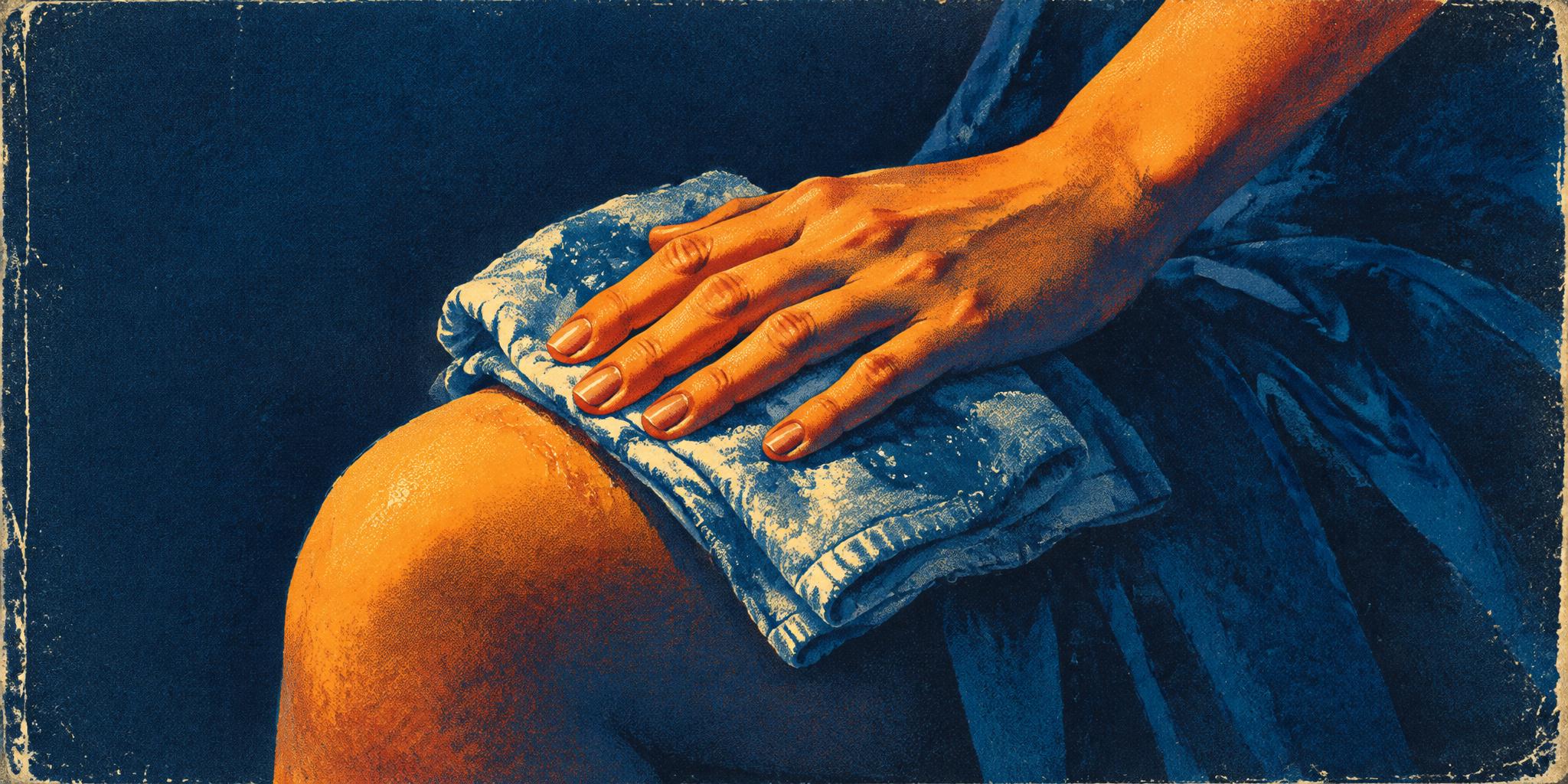
Marisol runs the kitchen tap until the water comes cold, soaks two cotton dish towels, and wrings them only halfway. One goes across each shin, over her skirt, pressed flat under her palms. She sprays her forearms and the backs of her hands from the bottle, then touches her knee through the wet cloth to learn what it's doing. Cool, for now.
A dry towel, folded in quarters, goes under her thighs so nothing reaches the cushion.
It has been twenty-two years since the crash. Below a line across the middle of her chest, the skin has felt nothing in that time and sweated nothing. Her legs take heat in and keep it, and they can't tell her when it has become too much. Wet cloth does some of what sweat would. But skin left damp against a cushion, or made to carry her weight too long without a break, opens into sores, and a sore is weeks in bed on her side. So the wet goes on top and the dry goes underneath, and all night her hand travels between them, checking which one is winning.
Gloves on, the left thumb taped where it split. Headlamp clipped low on the frame, where her knuckles won't catch it. Thermometer in the side pocket she can reach without leaning.
The lobby door sighs open. The air finds her face first, then her forearms, damp and close. She leans into the first push and warmth rises off the sidewalk against her throat, the way heat comes up from a stove burner someone has just switched off.
Telephone Road is full. A man is replacing a gutter by headlamp, a radio hung from the top rung of his ladder. In one driveway, children take turns at a piñata while an uncle works the rope. Outside the elementary school a crossing guard in a reflective vest holds up her sign, and kids with backpacks cross toward the lit classrooms, one girl walking backward so she can keep talking to her mother.
The 9:58 bus has one wheelchair space open. The driver crouches to hook the straps to her frame, and the vent overhead blows straight down onto her wet arms. Her shoulders shake until her teeth click together. Below the line, nothing changes. She slides a hand under the towel on her left shin. Drier already than she left it.
Five past eleven
The pharmacy line runs back past the sunscreen shelf, half the bottles wearing orange clearance stickers. Ahead of her: a man in hospital scrubs, a woman in pajama pants with a toddler asleep on her shoulder, an old man holding a prescription bag he has already paid for, waiting to ask a question.
At the counter the pharmacist types her name, scrolls, scrolls back.
"Your order comes on the noon truck," he says. "Day crew shelves it. Tomorrow night, after nine, it'll be here."
She counts what's left in the cabinet over her bathroom sink. Two days, if nothing goes wrong.
"After nine," she says.
Twenty past midnight
Wendell's hours are hand-painted across the shop window: 11 PM–5 AM. Beneath them, sun-faded almost to nothing, the old ones still show through. Tues–Sat, 9–7.
Inside there are three box fans and a card table where two men play dominoes for no money. A young man in a fleece jacket waits with his elbows on his knees. He works days at the server building on Airport Boulevard, and the room treats him like someone just back from a long way off. One of the domino players asks what it's like out there. He says, "Cold." They laugh, because he says it every week.
Wendell cuts Marisol in her own chair. Years ago he worked out that the barber chair meant two transfers and half an hour, and that he could lower himself instead. He drags a padded stool in behind her, sits with his knees wide, and snaps the cape closed at her throat.
"Same as always?"
"Shorter."
"Shorter than always."
"Take the back up. All of it."
He gathers her hair in one hand and lifts it, and the nearest fan reaches the back of her neck for the first time since spring. She closes her eyes.
"Nice night," Wendell says. In the mirror she can see him sweating at the temples, under his arms, in a dark stripe down his spine. His forearms shine. Every few passes he wipes his palm on the towel over his shoulder. Three box fans are enough for him.
She reaches back, finds his wrist, and brings his hand around to rest on her shin, over the cloth.
He takes it away fast.
"Mari."
"The vent on the bus dried the towels out. Keep cutting."
The clippers buzz up the back of her skull, and she feels every tooth. Here, above the line, she has all of it: the comb dragging, the small itch of hair falling inside the cape, his breath at her ear when he leans in to check an edge. After twenty minutes the blade has gone warm against her nape.
"Hot," she says.
He sprays the blade from a can of coolant, shakes it, waits. Then he takes the water bottle from the counter, mists the bare skin he's made, and turns the fan toward her. The cold travels. She can follow it down her back as far as the line, where it stops.
She locks her brakes. Wendell lifts the clippers and holds them off to one side. She hooks her right elbow behind the push handle and leans out over the wheel until her left hip comes up off the cushion, and stays there, counting under her breath. One of the domino players looks up, then back down at his tiles. The clippers hum in Wendell's raised hand. When she comes upright she leans the other way and counts again.
He goes back to work with his chin tucked, watching the line he's cutting.
"Summer of '23," he says, "the airport didn't go below eighty-four one night. The whole night. I remember because I still had day hours. Went home and slept in the car with the engine running."
"In your own driveway."
"Gloria thought I'd left her."
The young man in the fleece laughs into his collar.
"You get the van booked?" Wendell asks. "So you're not sitting out on that bench?"
"Line opens at five."
"Five tonight?"
"Five this morning."
The clippers stop. In the mirror he looks at her, then up at the clock over the door, then bends to her neck again.
When he's finished he holds the hand mirror behind her head. Her neck is bare to the hairline. She runs her palm up it against the grain, rough, and down again, soft. The fan keeps finding it.
Twenty to five
The first bus home has both wheelchair spaces taken: a man asleep in a power chair with his chin on his chest, a woman on a scooter with shopping bags hanging from the handlebars. Through the windshield the driver meets Marisol's eyes and lifts one hand off the wheel, palm up. She waves him on before he can lower the ramp.
Twenty-six minutes to the next one.
The towels on her shins have dried stiff. She sprays them, sprays her arms and the new bare skin at the back of her neck. The water beads and goes, and she feels it going. She lifts the edge of the cloth and presses her fingers to her shin. Warm. She lays her other palm flat on the metal bench beside her. Warm too, at twenty to five in the morning.
A pressure has started behind her eyes. Across the road, the streetlight has grown a soft ring. She drinks, puts the thermometer in her ear, reads it, puts it away. She drinks again.
At 4:59 she dials. At 5:00 a recorded woman thanks her for calling and tells her that call volumes are higher than usual.
The hold music is a piano piece that loops every forty seconds. By the third time around she knows where the seam is.
The 5:06 comes at 5:09 with one space open. She rides with the phone on her lap, on speaker, the piano thin under the roar of the vent. Her shoulders shiver. A woman across the aisle eats cereal out of a plastic cup, her shift badge still clipped to her pocket. The rings around the streetlights are smaller now. Marisol can't tell if that's the cold air or the bus moving.
"Thank you for holding."
She sits up. Gives her rider number, her address.
"Travel date?"
"Tonight."
Keys tap. "I can't book same-day trips, ma'am. The earliest I can give you is Wednesday."
The bottle in the cabinet over her sink holds enough for tonight and Wednesday.
"Wednesday, then."
The pharmacy address. Pickup at 9:30 p.m. The agent tells her the van may come any time in the half hour after that, so she should be downstairs by 9:30 and ready to wait. Return at 10:30.
"P.M.," Marisol says, for both.
"P.M.," the agent says. Marisol writes the confirmation number on the inside of her wrist with the pen from her side pocket. The ink skips over a damp patch, and she goes back over the digits until they hold.
Quarter to six
The window unit has kept the bedroom cold all night. She transfers to the bed, lifts each leg up after her by the knee, and turns onto her right side. With the long-handled mirror angled behind her, she checks the backs of her thighs.
Under the left one, where the folded towel went damp sometime after four, there is a red patch the size of a coin.
She reaches back and presses it with a fingertip. The skin goes pale under her finger. When she lifts away, the red comes back, slowly.
She stays on her right side, off it, and sets a timer on her phone for thirty minutes, to look again.
Outside, a delivery truck backs toward somebody's loading dock, beeping, the first of the day crew. The edge of the blackout cloth has gone gray. She lies with the mirror by her hand and the timer running, and draws her palm up the back of her neck, against the grain, while the room's cold settles over her shoulders.
-
When warning signs fail: The Consortium for Spinal Cord Medicine's clinical guideline on autonomic dysfunction lists dizziness, headache and visual disturbances as possible signs of overheating after spinal cord injury, but warns that some people show nothing beyond a rising temperature.
-
The seat's own weather: A 2024 systematic review of wheelchair cushion microclimate found that foam, gel-hybrid and air cushions trade off heat and moisture differently, so no single cushion is coolest and driest for everyone.
-
Why same-day rides vanish: The federal paratransit rule, 49 CFR §37.131, requires agencies to accept trip requests made the day before, which leaves a rider who needs a trip today with no guaranteed booking.
-
Nights that stop cooling: A May 2026 Nature Communications study of North American heat stress projects more nighttime heat stress, especially in the eastern United States and along coasts, which narrows the relief that moving life into the dark is meant to provide.
