
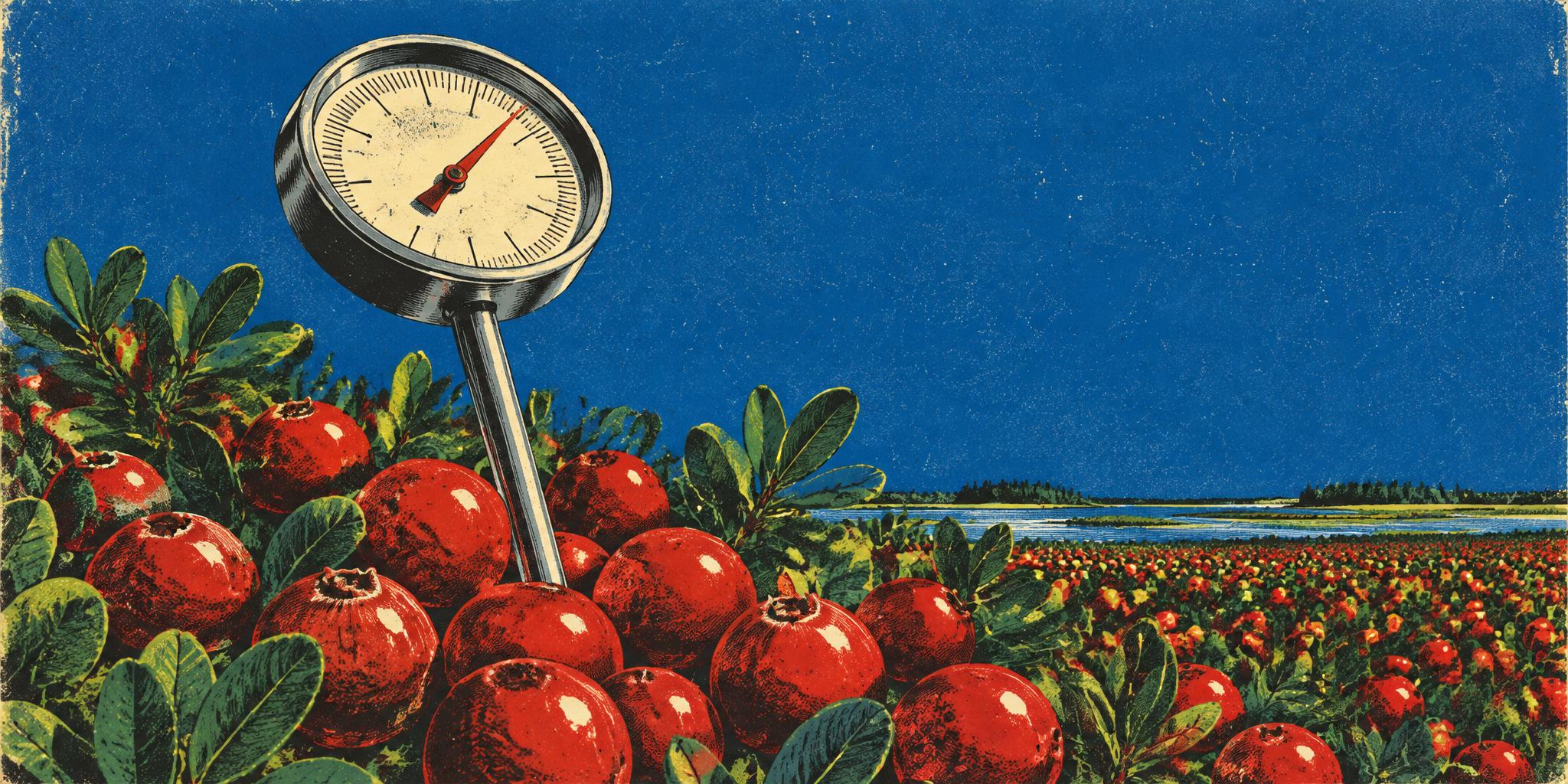
A family farm in the Pine Barrens takes the temperature of the fruit itself, because the forecast doesn't measure what the berries are going through.
The afternoon that worries a cranberry grower in southern New Jersey is one most people would call a nice summer day. Strong sun, hardly a cloud, air around 90 degrees and fairly dry, with humidity somewhere between 35 and 45 percent. People stay outside in weather like that; it's the sticky days that drive them in.
On those afternoons, the crew at Cutts Brothers, a family farm in Bass River, Burlington County, walks the beds carrying a meat thermometer, the same kind plenty of households will push into a turkey on Thursday, and pushes it into the berries. When it reads 108°F or higher, the sprinklers go on.
Shawn Cutts, a fifth-generation grower who has worked on the farm since 1997, described the routine to WHYY's Jaysa Dold this month. "The berries can actually cook on the vines," he said, "and it'll ruin them."
The air and the berry
Cranberries grow on low vines that spread across shallow, flat beds called bogs. By midsummer, the berries on top sit in full sun all afternoon. A Rutgers fact sheet by Peter Oudemans and Giverson Mupambi explains that the skin of those exposed berries can run up to 30°F hotter than the air around them, depending on sun, wind and humidity. Research they cite found that fruit held at 108°F for two hours is permanently injured. Growers call the damage scald.
That means an afternoon the forecast calls an ordinary 90 can leave the top layer of fruit close to ruin. The thermometer replaces a guess from the air temperature with a reading taken from the berry, and it leaves the decision with whoever is crouched among the vines during the hottest hour of the day. When the water goes on, it cools the fruit as it evaporates, the way sweat cools skin.
Scalded berries can go on to rot, a fungal disease that has troubled New Jersey bogs for a long time. Cutts told WHYY that growers in Wisconsin and Quebec deal with less rot than he does. New Jersey is the southernmost state where cranberries are grown commercially, and he thinks of it as the place where changes to the crop turn up first.
What the relatives remember
Cutts grew up hearing older relatives talk about colder weather in the 1970s and '80s. In his own working years, he told WHYY, he has seen more heat and more extreme weather. Rutgers' State of the Climate: New Jersey 2025 covers the same stretch of time: the state's average summer temperature rose 3.2°F, give or take half a degree, between 1970 and 2025.
A statewide, season-long average can't account for any one bad afternoon in one bog. This crop, though, is hurt by its hottest hours, with sun adding as much as 30 degrees on top of the air. In summers that run warmer overall, more afternoons start out closer to 108.
A bigger forecast that hides the work
In August, the U.S. Department of Agriculture forecast New Jersey's 2026 crop at 610,000 barrels (a cranberry barrel is 100 pounds), about a third more than last year. The figure counts fruit. It has no way of separating berries that were never in danger from berries the sprinklers kept from scalding.
Federal crop insurance counts the same way. Under the cranberry policy, a payment depends on how far the harvest falls short of the crop the policy guarantees. Running pumps in July and paying a crew to check fruit aren't part of it. Anyone who has paid for a sump pump and then watched a storm pass with the basement still dry knows how this goes: the pump shows up on a receipt, and nothing records the flood that didn't happen.
Choosing vines for people not yet farming
Thermometers and sprinklers get a farm through this summer. Cutts also talked with WHYY about breeding, the slow work of developing new cranberry varieties, which programs like Rutgers' carry out and growers then plant. "Sometimes solutions are ones that the next generation will benefit from," he said.
Cranberry vines come back year after year, so a bed planted with one variety is meant to produce for a long time. When the state agriculture department visited in 2019, it counted 29 bogs on the farm, planted with older varieties, Early Black and Stevens, alongside newer ones from Rutgers. Whoever chose the vines for each of those beds was planting for growers who would come after them.
Those growers will also inherit the thermometer routine, which is simple enough to teach a new hire on the first day: on a clear, dry afternoon, check how hot the berry is before trusting the forecast.
