
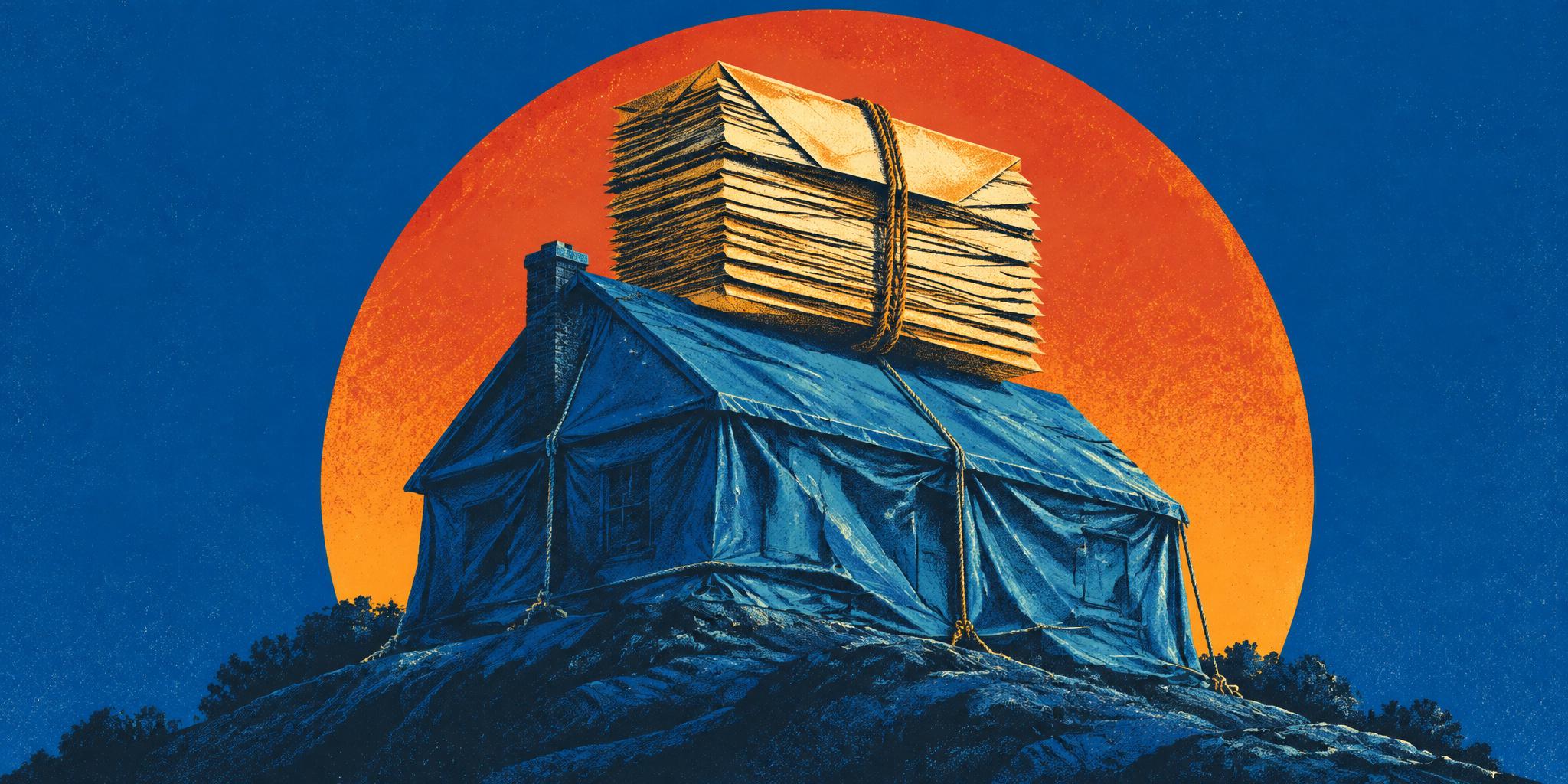
Florida homeowners bought the insurance their mortgages required. A new study shows what happened to those loans when the insurers couldn't pay after a hurricane.
Four years ago this month, a check arrived at Melanee Packard's house in North Port, Florida. It was dated November 12, 2022, about six weeks after Hurricane Ian crossed the southwest of the state, and it was made out for $1,882.
Packard had asked contractors she knew to look at the damage to her roof, a wall and ceiling, her pool and her fence. Their estimates came to about $40,000. Her policy carried a $6,000 deductible, the share she had to pay herself before insurance paid anything. Her insurer, United Property & Casualty, had offered a settlement on October 31, and she says she turned it down.
In April 2023, Stassy Olmos of Tampa's ABC affiliate reported on her claim. The water spots inside had turned to mold by then, and Packard couldn't get anyone at the company to answer her about the dispute. UPC had already been declared insolvent and ordered shut down. She had started a crowdfunding page for the repairs, and she was worried about a second problem: finding a company willing to insure a house with plastic on the roof before the next hurricane season.
"I have a plastic-covered roof!" she told Olmos.
Much of Florida's insurance story in recent years has been about premiums people can't afford. My colleague Seth Carrington wrote earlier this year about the escrow letter that arrives when premiums jump and pushes households out of homes they can no longer insure. Packard's trouble came from the other direction. She had paid, and the company that collected her premium went under while her claim was still in dispute.
A homeowner's policy carries two promises: to pay for damage that has already happened, and to cover the next storm. When the insurer fails, each promise is handed to a different party on a different schedule, and the family is left to keep track of both. If there's a mortgage, there's also a lender with deadlines of its own.
Who handles what after an insurer fails
Florida has a safety net for the old damage. The Florida Insurance Guaranty Association, or FIGA, is a nonprofit the state created to take over claims when a licensed insurer fails. Under Florida law, it generally pays up to $500,000 for damage to a home and its contents, but never more than the failed insurer owed. A dispute over what the damage is worth carries over to FIGA. The distance between Packard's $1,882 and her $40,000 would become FIGA's to settle, under the same policy terms, deductible included.
Coverage for future storms just stopped. Every UPC policy was cancelled on March 29, 2023, thirty days after a Leon County court ordered the company liquidated. Families still waiting on claim money had a month to find a new policy, often for a house that new insurers would rather see repaired first.
Olmos's report doesn't say whether Packard had a mortgage. For households that do, a third set of rules comes in. A home loan requires the house to stay insured without a gap, and the company that collects the monthly payment, called the loan servicer, checks for that. If the old policy ends and no new one shows up, the servicer can buy coverage itself and bill the homeowner. This is called force-placed, or lender-placed, insurance. According to the state insurance regulators' association, it usually costs significantly more than a policy you'd buy on your own, and it generally leaves out your belongings and your liability if someone gets hurt on the property.
Federal rules require the servicer to warn you in writing before it charges for that coverage. The warning period doesn't keep the old policy alive, though, and once the charges start, they can reach back to the day it ended.
Through all of this, the regular mortgage payment stays due. The Consumer Financial Protection Bureau's disaster guidance tells borrowers who can't pay to call their servicer and ask about relief. A pending claim with a failed insurer doesn't put that request on file.
The money a family has to front
Each of those organizations has a defined job, and none of them is responsible for the stretch in between, when the roof is open, the claim is unresolved, a new premium is due and the mortgage comes out on the first of the month. The household covers that stretch with whatever it has.
A family with savings can hire a roofer and keep arguing with the claims office. A family without savings borrows, waits or asks for help, the way Packard did when she put her repairs on a crowdfunding page. Waiting costs something too. Water keeps spreading, and a house in worse shape is harder to insure.
FIGA's records show how long a failed insurer's claims can drag on. When UPC was liquidated, FIGA took over 15,140 open Florida claims. By the end of 2025 the count had grown to 25,019, and 658 were still open, nearly three years after the shutdown order. A closed file records a decision on the claim. It doesn't say whether the repairs ever got made.
What the new study measured
Economists Sastry, Sen and Tenekedjieva wanted to know whether that strain shows up in mortgage payments. Their paper, "When Insurers Exit," has been accepted by the Quarterly Journal of Economics, and they found that it does.
They studied Hurricane Irma, which hit Florida in 2017. Irma's path couldn't be predicted far in advance, so the places it struck weren't sorted by which insurers happened to sell policies there. Some hard-hit counties had many customers of insurers that later failed; others had few. The researchers compared the two.
An earlier version of the paper gives a sense of scale. It counted borrowers who were seriously behind, meaning more than 90 days late on payments or already in foreclosure.
The final paper uses Florida data from 2009 through 2018 to build a model of losses for Fannie Mae and Freddie Mac, the government-backed companies that buy a large share of American mortgages from lenders. It estimates that roughly a quarter of the losses they could expect on Florida mortgages over that period traced back to weak insurers. That's a modeled estimate of expected losses, not a count of money already lost, and it isn't a forecast for today's companies. The authors treat FIGA's slower, capped payments as part of how the harm happens. The study's published appendix doesn't separate how much came from delayed payments, smaller payments or the cost of replacement coverage, and a family would need different help depending on which of those hit them.
The insurance a lender requires in order to protect a loan, in other words, can help push that loan into default when the insurer fails.
What your lender actually checked
Plenty of homeowners reasonably assume the lender's sign-off means someone looked at whether the insurer could pay after a storm. The check is narrower than that. Lenders that sell loans to Fannie and Freddie follow their rules on which insurers are acceptable, and those rules rely on grades from private rating firms. An A from Demotech, which rates many Florida insurers, satisfies both. Fannie's guide says one passing grade is enough, even if another firm rates the company lower.
A grade is a rating firm's opinion of a company's finances on the day it's issued. It decides whether a policy counts for the loan, but it doesn't speak to how the company will handle thousands of claims landing in the same month. The losses in the study fell on Fannie and Freddie themselves, on loans whose insurers were vetted in basically the same way, and the system still runs on grades today.
Where Florida's market stands now
The market is calmer than it was in 2022. Six Florida-based home insurers were shut down between February 2022 and February 2023, the last of them UPC. The state regulator's July report said no home insurer had since been referred toward shutdown or a state rescue, and FIGA says it hasn't taken over a newly failed insurer since early 2023. The same report says eleven companies are under closer watch, without naming them in that section. A household reading it has no way to tell whether its own insurer is on the list.
Meanwhile, a lot of households have changed insurers without ever going shopping. Citizens, the state-backed insurer for people who can't find coverage elsewhere, has shrunk to 215,131 policies as of November 13. Most of that came through "takeouts," in which private companies assume its policies: 585,432 in 2025 and 168,658 more through October 20 of this year. Several of the companies taking those policies were licensed only in 2025. A short history doesn't by itself make a company weak, but it leaves a household with little besides the rating to go on.
Plenty of Florida families sitting down to Thanksgiving on Thursday will be insured by a company that took over their Citizens policy, not one they chose.
If your insurer fails
- Check now whether your insurer is "admitted." That means fully licensed and regulated by the state, and only admitted insurers are backed by the state's guaranty fund. Florida's is FIGA. Every state has its own, with its own limits. Surplus-lines policies, often sold for hard-to-insure homes, have no such backstop. Your agent can tell you which kind you have.
- If your insurer fails, the cancellation date comes first. Line up new coverage to start that day, and send proof to your servicer in a way you can document, before a forced policy fills the gap.
- Watch where the refund goes. In UPC's case, premium refunds went straight to policyholders even when the servicer had paid the bill from escrow, the account funded by your monthly mortgage payment. Set that refund aside. The new policy still has to be paid, and with the money in your hands instead of the escrow account, the servicer may come up short when the bill arrives.
- Keep the notices about the shutdown. The court sets a deadline for filing claims, and later deadlines for disputing them follow from it. For UPC, the filing deadline came one year after the shutdown order.
- Call the servicer early. Tell them the insurer failed and the repair money is stuck. Ask what relief exists, when payments resume and how missed amounts get repaid.
Hurricane season officially ends next Monday, November 30, and claims from this year's storms will run well past it. The study estimates what weak insurers cost the mortgage system. A household can work out its own version: how many months it could cover a roofer, a new premium and the mortgage at the same time if the claim money stopped moving. In the spring of 2023, Packard was getting by with plastic on the roof and a crowdfunding page.
- The study's full tables: The accepted Quarterly Journal of Economics article, "When Insurers Exit," should show which insurer failures drove the default estimates and how long after a storm the researchers measured missed payments.
- Eleven insurers under watch: Florida regulators' July 2026 stability report puts eleven companies under enhanced monitoring without naming them in that passage, so it's worth watching whether that count changes in later reports.
- Who's behind cheaper renewals: Most of the nine companies on the state's October rate-decrease chart carry Demotech A ratings affirmed in September, but nothing in the record yet shows whether the lower prices came with stronger finances.
- New companies taking Citizens policies: Several insurers that took policies out of Citizens this year, including Mangrove and Apex Star, got their Florida licenses only in 2025, according to the regulator's list of newly licensed entities.
