

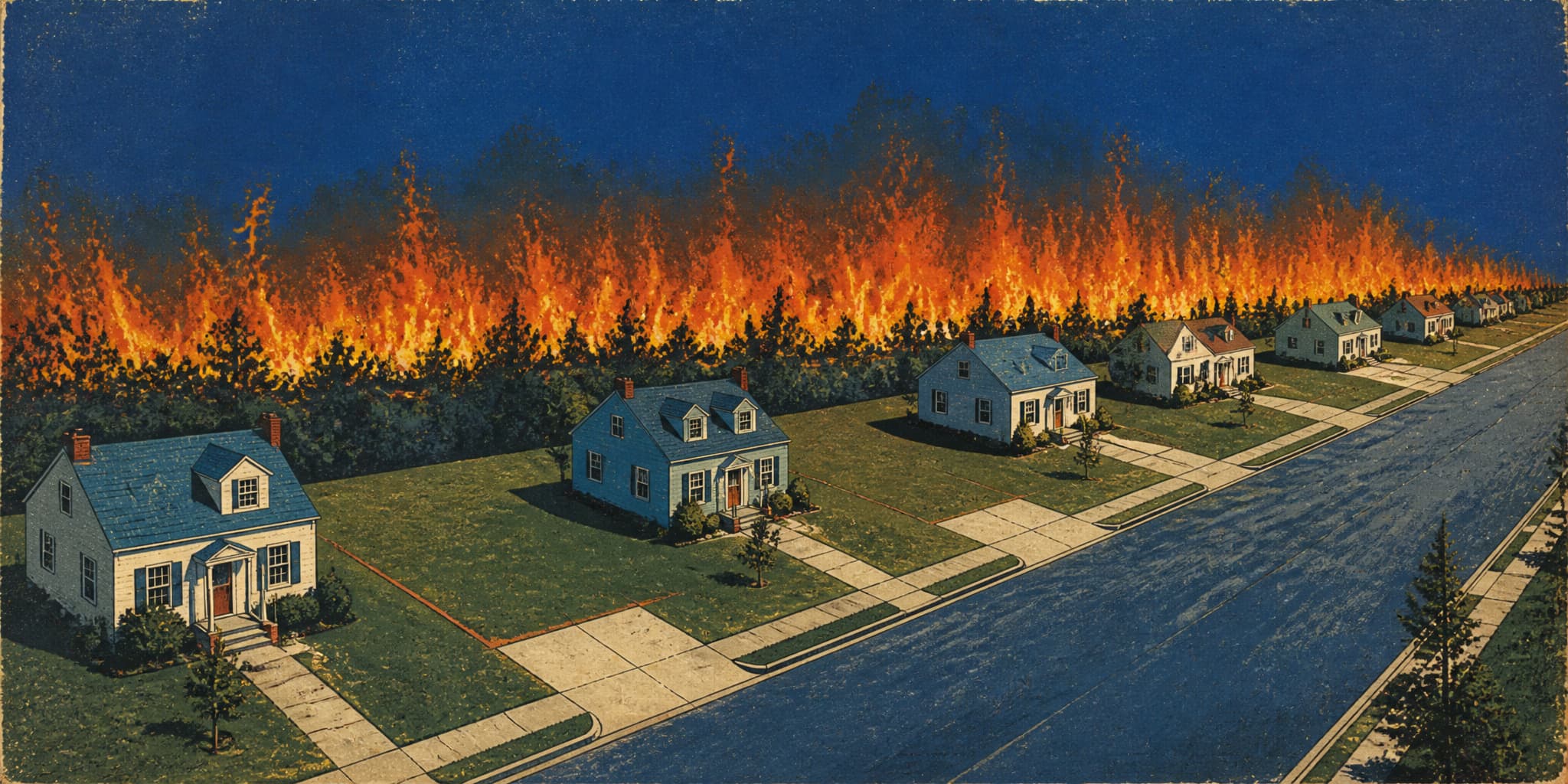
In Montgomery County's repeat-flood neighborhoods, the water hits every house on the block at the same hour. The remedy reaches them years apart. What's left is something that used to function as a street.
Kathleen Adams has lived near McDade Park in Montgomery County for twenty-eight years. She raised a family in that house. It had a pool, a 1,400-square-foot porch, room enough for reunions. Now much of her life is boxed upstairs, above the waterline that keeps finding her. She is seventy-eight. She has spent more than $50,000 in repairs. She has been waiting six years for a buyout that hasn't closed.
"You start paying attention when it's sitting at your front door," Adams told Community Impact this spring. "You have to."
She pays nearly $2,400 a year in flood insurance through the National Flood Insurance Program. Without it, she wouldn't qualify for the buyout. The insurance is the cost of staying eligible for a program that hasn't reached her yet.
"I love it here," she said. "I have so many mixed emotions about leaving it, but I can't stay."
Seven miles south of downtown Conroe, Brandon Road cuts through the River Plantation subdivision, one of the best-documented repeat-flood streets in the county. Adams's block near McDade Park isn't Brandon Road. But it sits inside the same county program, the same two federal funding sources, the same years-long queue. And on Brandon Road, you can see what the waiting produces when it stretches long enough for neighbors to come apart from each other.
Reading the street
River Plantation sits east of I-45 along the West Fork of the San Jacinto River. In 2024, portions of the community flooded twice: late January, then early May. During Harvey in 2017, some homes took twelve to fourteen feet. As of late 2024, fifteen of the county's 124 completed buyouts had been in River Plantation. By May 2026, the countywide total reached 144, though updated neighborhood-level figures weren't publicly available.
If you know what you're looking at, you can read the adaptation history of the street house by house.
Jimmy Lee's place sits eight feet above his surrounding neighbors, behind a retention wall he built himself. From up there, he's watched the street thin. "My neighbor bought the house next door for his daughter," Lee told Community Impact in November 2024. "After it flooded the first time, they rebuilt. But now with this last flood, they moved out and left the house gutted from inside."
That gutted house is one kind of leaving. No program, no buyout check, no green-space conversion. A family hit its limit after the second flood and walked away from whatever equity was still inside those walls. From Lee's elevated porch, it shows up as a gap in the row: a structure nobody is maintaining, nobody clearing the drainage around, the yard growing into whatever the San Jacinto bottomland wants it to become.
Down the street, Marquita Calderon's home flooded twice in 2024 and was determined "substantially damaged" by the county. Under FEMA's floodplain rules, a substantially damaged home has to come into compliance: demolition, elevation, or opening the bottom floor to let water pass through. Calderon and her husband chose to rebuild. They stayed up until 3:30 in the morning during one flood bailing water, sandbagging every window and door. They put the house on the market while still making repairs.
"I honestly regret ever buying this house," Calderon said, "because now I kind of just feel like I'm stuck here."
She is rebuilding and trying to sell at the same time. A substantially damaged home in a repeat-flood zone, listed in a market where regional studies have documented anywhere from a 10 to 30 percent drop in values after significant flooding events. Flooded areas across the Houston region did not appreciate between 2016 and 2019 while non-flooded land gained 25 percent.
"It is what it is. We're rebuilding. We're back in our house. But this is going to happen again."
And then there are the lots where houses used to be. Fifteen buyouts in River Plantation means fifteen foundations demolished, fifteen parcels regraded and returned to green space in perpetuity. The county describes this as restoring "the natural flood function" of the land. From the street, it looks like a concrete driveway apron leading to a flat, grassy rectangle where a family used to live, bordered on one side by someone who elevated and on the other by someone still deciding. The outline of the old foundation sometimes shows in how the new grass grows differently.
Lee, elevated. Calderon, rebuilding to sell. The neighbor's daughter, gone. The buyout lot, growing grass. From any point on Brandon Road you can see at least two of these outcomes within a few hundred feet. None coordinated with the others. The water hit every house at the same hour. The remedy arrived years apart, and between those two facts, every household was forced into a different irreversible decision on its own money and its own tolerance for waiting.
What holds when density thins
"Just because you're above it does not guarantee that you're not going to flood again. Maybe you are above water, and maybe you don't flood. But now you're an island. And what happens if you have a medical emergency?"
— Morgan Lumbley, Montgomery County recovery manager
Lumbley's question reaches past Lee's retention wall into something more basic about what a street is actually for. Jamie Goodman, president of the River Plantation Community Improvement Association, told reporters that when disaster strikes, unaffected neighbors help residents rebuild. That mutual aid depends on there being unaffected neighbors. It depends on there being neighbors at all. Every buyout that closes, every family that walks away from a gutted house, every lot that returns to grass widens the distance between the people who remain.
River Plantation has its own Municipal Utility District, which carries maintenance responsibility for shared drainage infrastructure. But the MUD's work assumes a certain density of occupied, maintained properties. No publicly available source documents what happens to block-level drainage when buyouts thin a street unevenly, when grading shifts because one home went up eight feet and the lot next door was scraped to bare earth. The county's drainage criteria manual was written for neighborhoods that function as neighborhoods. Brandon Road is becoming something else.
Fifteen families have been bought out of River Plantation. No public source documents where they went. In Harris County, a Rice University study of approximately 1,500 buyout participants found that homeowners from less affluent and more Black and Hispanic neighborhoods dispersed farther in search of affordable housing. Those with home values around $80,000 moved three times farther than those with homes valued at $280,000. Whether River Plantation's fifteen follow that pattern, nobody on Brandon Road seems to know where they landed. The buyout removes a house from a floodplain. It also removes a person from a phone tree, a sandbag line, a 3 a.m. knock on the door when the water is rising.
The background clock
The institutional timeline that produced this house-by-house divergence isn't complicated to describe. It is just slow.
Montgomery County launched its buyout program in 2020. Through six FEMA and HUD grant cycles, the county had spent $28.72 million on 124 homes as of late 2024. By spring 2026, the total reached 144 buyouts countywide. As of spring 2024, about 300 homes were eligible. About 100 additional people had called asking to be included. In December 2025, county commissioners approved extensions on two disaster recovery grants, one tied to Harvey, one to a 2016 storm. The Harvey extension runs through February 2027. Nine years after the storm.
Lumbley has said the full process typically takes two and a half to three years once funding reaches the county and homeowners stay engaged. But funding doesn't reach the county on anyone's household timeline. "We have zero control as to how long things sit at the federal and state level," she said. Jason Millsaps, executive director of the county's Office of Emergency Management, called the process "an atrocious amount of work."
Nationally, half of all FEMA-funded buyouts take more than five years from disaster to closeout. Insurance payouts usually take six months.
At roughly 29 buyouts per year countywide, clearing the current list of 300 eligible homes would take a decade. The list grows after every flood.
The county received $2.2 million from FEMA in September 2024 for its first-ever elevation program, covering seven homes. "We haven't done elevation in Montgomery County," Lumbley said. "We'll see how it works to see if it is a continued, viable option. But I think buyouts, really, it's the final mitigation option. It's probably the way to go." Seven elevations. Three hundred eligible. In two years, Brandon Road will likely have a few more empty lots, a few more families who left without waiting, and the same elevated house watching the street continue to thin.
Calderon believes the flooding is a management problem, that the San Jacinto River Authority's releases from Lake Conroe cause it and the fix is "simple." The SJRA's general manager has responded that the dam actually lessens natural peak flows. The disagreement shows residents reaching for a lever somewhere in the system, some decision-maker they can petition, some human choice they can reverse. The river doesn't attend community meetings.
What $50,000 buys
Each of Adams's repairs deepened her investment in a property whose underlying conditions had permanently shifted. Each season she stayed, she spent money that moved further from recoverable. The buyout, if it comes, will appraise her home at fair market value. Fair market value in a repeat-flood zone that has flooded repeatedly.
Tammy Gunnels, a Montgomery County homeowner whose property flooded thirteen times in eleven years before her buyout finally closed in 2021, described the financial architecture plainly:
"When you flood, yeah, you get insurance. But the lien holder on your home gets the money. The lien holder releases it in increments so that you make the repairs. They inspect the repairs before releasing the next payment. There IS no walking away."
Gunnels's property had received more than $750,000 in NFIP payouts over eleven years, more than three times its fair market value. Her buyout closed for $250,000. Lumbley wrote "No one before Miss Tammy. Number one priority" on her computer screen and left it there until closing.
Adams is still earlier in that arc. She has the NFIP policy, the repair receipts, the flood history, six years of waiting. She doesn't have a closing date, a replacement plan, or any certainty about what the $2,400 annual premium is actually buying beyond continued eligibility for a program that processes one household at a time.
"It's the little things I've lost through life that I'll never be able to replace," she said.
Fewer neighbors every season
Lumbley's office gets more calls after every flood. "River Plantation is really popular because we've purchased so many out there," she told reporters. "People are aware that it's there." Awareness of the program spreads through the same neighborhood relationships that the program is dissolving, house by house. The information travels through connections that won't survive the remedy.
Living on a block where everyone chose differently, or where the program chose for them by arriving at different speeds, looks like this: the street doesn't empty all at once. It empties in a pattern that looks, from above, like a mouth losing teeth. The people who remain can still see each other's houses. They just can't count on each other the way they could when every porch had someone sitting on it, when the phone tree had no dead numbers, when the drainage system had no unmaintained lots breaking the chain.
Adams watches the weather. She tracks the river levels. She keeps the insurance current. Around her, on blocks she may or may not be able to see from her upstairs windows, her county is adapting one house at a time. She waits for a closing date that will let her leave the home she loves, the home where the porch used to hold reunions and the pool sits empty. The program that might eventually reach her depends on neighbors telling neighbors it exists. Fewer neighbors every season to carry the word.
-
New FMA grant round: Montgomery County submitted applications for a new FEMA Flood Mitigation Assistance grant cycle with a May 22, 2026 deadline, but whether the county's submission was accepted and how many properties it covers has not been publicly disclosed.
-
Kerr County's fresh clock: Governor Abbott said 135 Kerr County homes were destroyed or heavily damaged in July 2026 floods, and the county is already asking residents to report damage through the iSTAT portal while warning that reporting does not guarantee aid or substitute for an insurance claim.
-
Buyout tracking still unbuilt: GAO recommended in 2022 that FEMA implement property-level milestone tracking for buyouts, which would make timelines like Adams's visible across the program; as of mid-2026, that recommendation remains unimplemented.
-
Where buyout families land: A Rice University study of roughly 1,500 Harris County buyout participants found that homeowners from less affluent neighborhoods dispersed significantly farther than wealthier participants, but no equivalent tracking exists for Montgomery County's 144 completed buyouts.