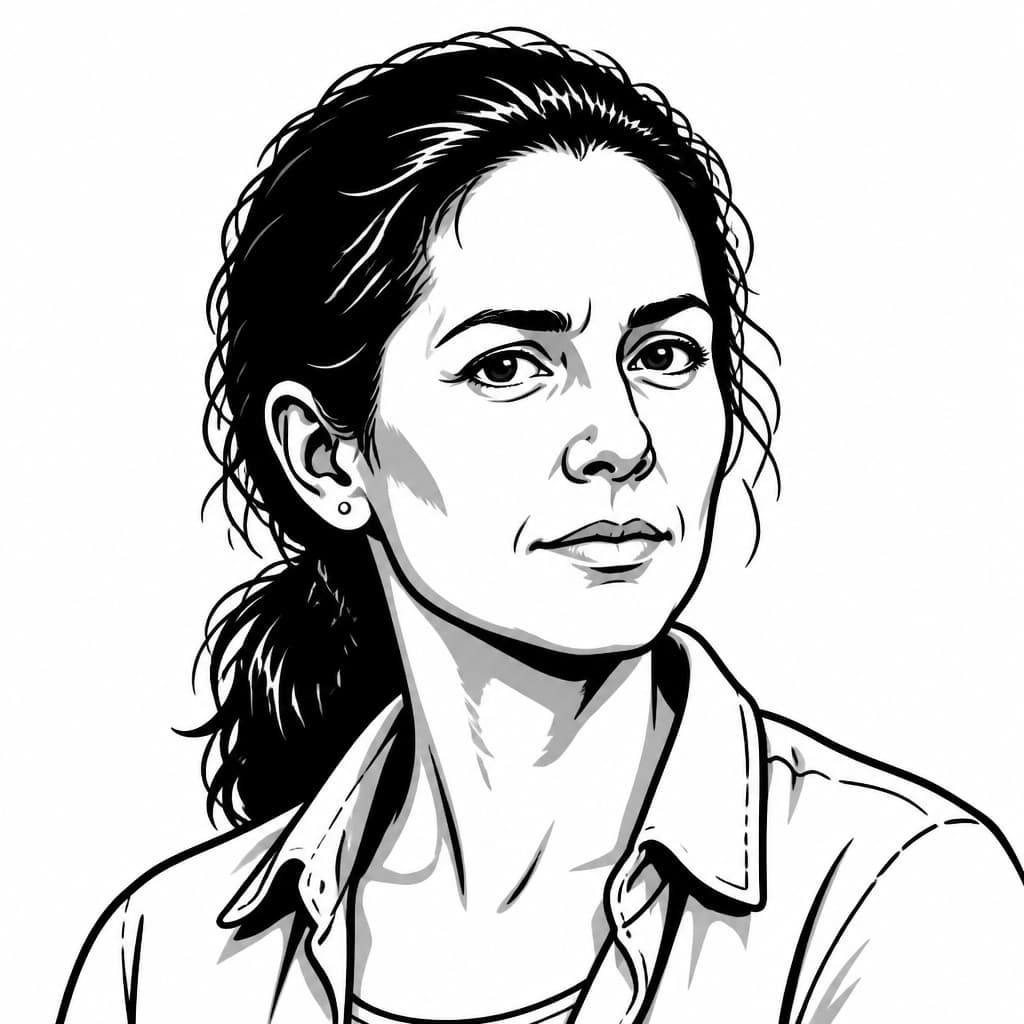
Della stood where the water used to reach.
The Clearwater had pulled back from the old cobble line by the width of a road since she'd started coming to this ground, and she'd started coming before she could walk. Her mother carried her. Now she walked herself down over the exposed stone to where the current still ran, and the cobble was dry and pale and already warm through her shoes at five-thirty in the morning. June second. The canyon walls held the dark a while longer. Above them the sky had gone white.
She crouched and put her hand in the water. Warmer than her skin. She held it until the current pushed between her fingers and she could feel the speed of it, faster than it looked, the way a shallow river always was. Clear enough to see the bottom, which meant too clear. Snowpack gone early. The pulse that belonged to this week had come through in April instead, thin and quick, and what ran now was whatever the ground still gave up.
Up the bank, people were setting the tables under the cottonwoods. Three of the big trees had died standing since last year. Their bark hung in long strips like skin off a sunburn and the morning light caught the pale wood underneath. The living ones still leafed, but the canopy was the kind you could read through, light and shadow mixed, nothing like the solid dark she remembered from her twenties, when you could sit under a cottonwood at noon and lose the sun entirely.
She dried her hand on her pants and climbed back up.
Plywood on sawhorses, same as every year. Willa and her daughter had laid out the service: water in the steel pitchers that had been Della's mother's, venison from the November hunt dried and shredded, camas from the Weippe dig, serviceberries dried last August. The order was set. Water first, then the place for salmon, then deer, then roots, then berries. Everything present except the thing the morning was supposed to begin with.
The place for salmon was a steel tray, empty, centered on the middle table. Willa had polished it. It caught the early light and threw it back, a bright blank rectangle Della could see from thirty feet away.
Wilson had called from the commission office six days ago and been brief about it. The spring run at the lower dam remnants — what used to be Lower Granite, now a half-collapsed weir the compact kept as a counting station — had passed eleven adults. Total. For the whole Clearwater system. The ten-year average was forty-three, and forty-three would have put Della's mother on the phone to a lawyer. Eleven was not a number you allocated from. Wilson said he was sorry and that the commission would note the shortfall in the seasonal record. Della said she knew he was sorry, and hung up.
She'd told Cass. Nobody else, because the number would travel on its own through the channels it always traveled — Wilson's office to the council, council to the longhouse coordinators, coordinators to the families — and she didn't want to be the mouth it came out of. She wanted the system to carry that weight for once.
The system carried it, and the families came anyway. Forty-some already, more turning off the highway. They came the way you come to a thing you have always come to. The alternative was staying home, and staying home was a different kind of statement, and nobody wanted to be the first house to make it.
Cass had been up since four, hauling water from the pump station a quarter mile upstream where the compact's solar array still ran a filtration unit. The array was twelve years old and losing cells. You could see the dead ones from the road, dark squares in the bright grid like gaps in a jaw. It got the pump going around five-fifteen when the sun cleared the east wall and quit around one when the panels cooked. Eight hours. The gathering fit inside that window if you filled early and nobody got stupid with the rinse water.
Four fifty-gallon drums, food-grade plastic, strapped to the hand cart Alahmoot's people had welded out of bicycle frames and truck axle. Ugly cart. Worked. Cass had scraped the labels off the drums two years ago, after the smallmouth season, when stenciling NOT FOR HUMAN CONSUMPTION across barrels of food had permanently settled the question of how much a label was worth.
Water went into the pitchers, the cooking pots, and the handwashing station Willa built at the end of the table row every year out of the same two buckets and the same length of hose. Trucks were coming down the gravel now, a few people walking in from the houses along the creek. Cass nodded at them and kept moving. The setup had a rhythm that didn't need talking, and talking this morning meant the fish, and there was nothing to say about the fish that wouldn't land wrong on somebody.
Cass had been to eleven of these. Every one since Della took Cass in after Cass's mother died. Salmon had been on the tray twice. Once a frozen fish from the commission, thawed overnight in a cooler, flesh pale and soft and tasting mostly of the bag it had spent eight months in. Once a real one, small, out of a weir trap on Lolo Creek, and that one Cass remembered because Della cried when she saw it and then acted like she hadn't, and there had been enough for maybe a dozen people to have a piece the size of a thumb.
The other nine years, Willa polished the tray and the tray sat there and people ate around it.
Cass set the last pitcher down and heard a vehicle on the switchback — Tam's truck, the particular rattle of the passenger door he had never fixed.
Tam parked where the cottonwoods still threw shade and sat in the cab a minute with the engine off.
Four hours from the Grande Ronde on roads the compact's database listed as maintained. His suspension had taken the kind of beating that would surface later as a bill he couldn't pay. Fern had asked why he didn't just send the data. He said Della wanted him there in person. Fern said Della wanted a lot of things, and kissed him, and went back to her seedling flats, and he drove out into the dark.
The drive was in his shirt pocket. Two versions on it.
The one Della had asked for: thermal profiles for fourteen tributaries in the upper Clearwater and Snake where late-spring water still dropped below what a spring Chinook needed to hold and spawn. Gradients, seasonal curves, flow volumes. Enough to show the cold water existed. Enough to argue the biology would still work if the fish could get there.
The other version had coordinates. Every spring, seep, and shaded canyon reach at a resolution that would walk a stranger to the spot. He'd put it under Corin's key, the one she left him with instructions he still hadn't followed, and he carried it the way he carried anything dangerous, against his body and backed up nowhere.
He got out. The canyon was already loading up with heat, basalt taking the early sun and pushing it back at him, that dry mineral warmth that had nothing to do with air temperature. The river ran low and fast and the color of weak tea. Sediment. Somewhere upstream a bank had gone, or a tributary had flushed.
Della was at the tables watching him come down. She didn't wave. She never waved. She waited until you were close enough to talk to and then she talked.
"You brought it."
"The version you asked for."
"That's the one I asked for."
"Yes."
She looked at him the way she'd looked at the river an hour ago, reading what was there and what wasn't. "You'll present after the morning session. When people have eaten."
"If there's a morning session."
"There's a morning session."
Tam looked at the tray. He didn't ask.
Alahmoot came in at seven with a cooler in the truck bed and two of his people from the Clearwater station, both younger than Cass, both in the compact's gray field shirts with the sleeves cut off. The cooler was white and heavy and took both of them to get down.
He found Della at the water station and stood next to her without saying anything for a while, which was how they did it. Step-siblings who had learned decades ago that the first thirty seconds set the terms, and that silence was the only term neither of them had to concede.
"I brought lamprey," he said.
"From where."
"Clearwater fork. The translocation reach. My people took them last week." A pause. "Seven adults. Good size. Cleaned and smoked."
"That's not what the tray is for."
"The tray is for what the river sends."
"The tray is for salmon."
"The tray is for the first fish, and lamprey is a first food. It's in the order." He said it the way he said everything, level and unhurried, a man who had spent thirty years arguing to people with the power to say no and had learned they said it less often when you didn't raise your voice. "The river sent lamprey. We can wait on something it isn't sending, or we can honor what it sent."
"You know what this is about."
"I know what you think it's about."
"If lamprey goes on that tray, the record says lamprey. Seasonal record, compact filing, treaty reference. Every year after this, somebody pulls the file and it says the first food in 2071 was lamprey. And the year there's no lamprey either, it says what? Crayfish? Smallmouth?"
"It says what the river sent."
"It says we stopped waiting."
Alahmoot looked at the water. It ran shallow over the cobble and caught light in a way that made it look quicker than it was. Two dead cottonwoods stood at the edge with their roots half out where some past high water had undercut them, water that wasn't coming back.
"My people eat on four hours of power a day," he said. "Dworshak needs generation to run the hatchery. The translocation needs generation. The monitoring stations need generation. I can repair two of the four lower dams right now with materials and labor I already have. Two. That's the hatchery at capacity and twelve hours on the grid instead of four." He turned. "You want the dams open. Open to what? The mainstem's too warm for a fish to hold in and you know it. Tam's numbers — whatever he's got in his pocket — that's cold water in the tributaries, not in the river. Open the dams and you give the fish a path through water that kills them, to reach water that might not, if they find it, if there are enough of them, if the window holds. That's four ifs. I'm offering something that already works."
"What already works is lamprey."
"Lamprey proves the method. The hatchery makes Chinook if it has power."
"Hatchery Chinook."
"Chinook."
Della didn't answer that.
The session started at eight, while the east wall still shaded the tables and you could sit without the sun on your neck. Forty-six people. Della counted the way she always counted, which wasn't a head count. Who came. Who didn't. Who sat with whom. Who brought food and who came empty, which meant they'd eat off the common table, which meant the common table had to be enough.
The water was blessed. The pitchers went around. People drank. The order began.
The tray sat empty.
Della stood at the head and did not look at it. She looked at the people instead. Willa and her daughter. Alahmoot's two, already sweating through the gray shirts. Tam at the far end with both hands around a cup he wasn't drinking from. Cass behind the table, still holding a pitcher. Fourteen families from Lapwai and the creek communities, six from Kamiah, two from Kooskia who'd driven since before dawn. Harlan in a chair somebody had carried down for him, ninety-one years old, coming to this ground since before Della's mother carried Della here, saying nothing and missing nothing.
"The commission counted eleven fish at the station," Della said. "Total passage, spring run. No ceremonial allocation."
She let it sit. They knew. The number had traveled the way numbers travel, through families and council and the quiet business of people telling each other what they already suspect. But knowing it in your kitchen and hearing it said at this table on this morning were not the same transaction. One was private. This was the record.
"The question is whether we proceed."
A woman from one of the Kamiah families — Rae — said, "Proceed how."
"That's the question."
Alahmoot stood where he was, at the side of the table near his cooler. "I brought smoked lamprey from the translocation reach. Seven adults, taken last week by my people. Lamprey is a first food and it's in the order. I'm asking the gathering to consider putting it on the tray."
The quiet that followed had a lot of arithmetic in it and none of it on anyone's face. Della watched Harlan. Harlan watched the tray.
"Lamprey isn't salmon," said Dale, from Kooskia. Not arguing. Setting a stone down where everyone could see it.
"No," Alahmoot said. "It isn't."
"The ceremony waits on salmon."
"The ceremony waits on the river providing. The river provided lamprey."
"The river provided lamprey because your people put lamprey in it," Rae said. "That's the translocation. Those fish didn't swim here. They rode."
"They spawned here. Their young are in the tributaries right now. What we took last week was born in the Clearwater."
"Born in the Clearwater out of a bucket," Della said. "About as wild as the hatchery Chinook you want to make."
"Everything in that river is there because of what we did to it or failed to." Alahmoot's voice held, but Tam could see the cords come up in his forearms. "Salmon are gone because of the dams. Lamprey are back because of the translocation. The water's the temperature it is because of the sky. None of it is the river working alone. The river hasn't worked alone in a hundred and fifty years. If we're waiting on something with no fingerprints on it, we're waiting on a river that doesn't exist."
Dale's wife leaned over and said something into his ear. Dale shook his head at it. Over at the Kamiah table, Rae's son had his eyes on the cooler with the frank attention of somebody who'd been smelling smoked fish for an hour on an empty stomach.
Tam hadn't meant to talk. The argument had stalled on a question he could move.
"The cold water exists," he said. "Fourteen reaches in the upper system where late-spring temperature stays under what Chinook need. Some spring-fed, some just shaded canyon. Small. Easy to lose. But there."
"And with the dams open," Della said, "fish reach them."
"With the dams open, and if the mainstem doesn't kill them on the way. The window's narrow. Maybe three weeks, late May into early June, when the mainstem's cool enough to pass through. After that it's lethal."
"Three weeks," Alahmoot said. "You're asking us to open four dams — lose the generation, lose the hatchery, lose the translocation — for three weeks."
"I'm not asking for anything. Della asked me to present the data."
"And the data says three weeks."
"The data says the cold water is there. What you do about it isn't mine."
"Well, that's convenient," Dale said, and got a laugh, and Tam nearly smiled, because Kooskia had always had the talent for saying the room's thought in the fewest available words.
"Where," Harlan said.
Everyone turned. It was the first sound he'd made.
"The tributaries. Where are they."
Tam's hand started for his shirt pocket and stopped. It was nothing, a hand moving four inches and coming back, but Della saw it, and Cass saw it, and Alahmoot saw it.
"I can show thermal gradients," Tam said. "General locations. Enough to support opening passage."
"Not the coordinates."
"No."
"Why not."
Neither of them answered. Della had reasons and Tam had reasons and they were the same reason, and it wasn't a thing either of them could say out loud to a room full of people who needed to hear it: that a place stays alive as long as nobody with money knows exactly where it is. That the cold water was surviving because it was worthless on the compact's maps. That telling this room was telling the compact, not because anyone here would sell it, but because information does not sit where you set it. It moves — into filings, funding requests, council minutes, seasonal reports — and every move makes it more legible, and legible is priced.
"Coordinates put those tributaries on the resource map," Cass said.
Cass was still behind the table, still holding the pitcher, and it came out flat.
"Once they're on the map they're an asset, and assets get allocated. We put smallmouth on the record as nuisance removal, and now the compact runs the harvest as a nuisance program. We lost the label. Put cold-water tributaries on the record as salmon habitat and the compact manages them as salmon habitat, which sounds fine right up until somebody decides the habitat's worth more as water for something else."
"The treaty protects —"
"The treaty protects what the record says we have." Cass set the pitcher down. "Record says salmon, we've got a salmon right. Record says cold-water tributaries, we've got a cold-water-tributary right. And every one of those is worth exactly what the compact feels like honoring, which is nothing, because nobody up there cares what we catch out of a river they already wrote off."
Nobody said anything for a moment. It was the thing that lived under every argument they'd had at this table — the right real in law and gone in the world, the record their only weapon and also the thing that made them visible to systems that had stopped caring whether they could see them at all.
"So we do nothing," Alahmoot said. "We sit here with an empty tray waiting on a fish that isn't coming, protecting coordinates that get found anyway, holding a right nobody enforces."
"That's not what I said."
"That's what it adds to."
"What it adds to," Cass said, "is deciding what we're recording. We'll eat. We always eat. Willa brought venison, the families brought roots and berries and bread, nobody here goes hungry today." Cass looked down the tables. "The question is what goes in the seasonal file. What the tray says we started with."
Della looked at Cass and Cass looked back, and there was something in the set of Cass's mouth that Della had seen before on her daughter, years ago, before the drinking took her. I see what you're doing and I love you and you're wrong. Her daughter had been wrong about nearly everything and right about the one thing, which was that Della held lines well past the point where holding them helped anybody.
"The tray waits for salmon," Della said. "That's what the tray does."
"The tray's been empty nine of the last eleven years." Cass didn't raise it. "I've been at all of them. I've watched people eat around it. I've watched Harlan look at it and I've watched you look at it, and every year the seasonal record says no ceremonial allocation and the compact files it and nobody opens it."
"An absence is a record of loss. The empty tray says taken. It says the fish were here and now they're not. That's a claim."
"Made to who? Who reads the file? Who's going to pull the 2071 seasonal record and say, the tray was empty, therefore the treaty was violated, therefore we owe them the river back? It goes to the archive and the archive is a server in Spokane and the server is maintained by people who have never stood on this bank."
"Someone will read it."
"When?"
Della didn't answer. It was the question at the floor of every argument she'd ever made about the record and the right and the claim. When would the evidence be entered. When would the court that didn't exist convene to hear a case nobody had standing to bring. She held the line because the alternative was not holding it, and she had always known the line might never be called.
"She's right about one thing," Rae said, and the table tipped toward her. "We stop putting salmon on the tray, we stop saying we're owed salmon. The claim is the tray. But the kid's right too." She meant Cass, who was twenty-six and hadn't been a kid in anyone's memory except maybe Harlan's. "An empty tray in a file nobody reads is a tree falling in a forest nobody's standing in."
"That's philosophy," Dale said. "We're sitting in ninety-degree heat with forty-six people who need to eat and the camas window closing. I can't lose another dig day. Can we decide something?"
"We're deciding something."
"We're talking about deciding something. Those are different."
A younger woman down the end — Tam never got her name — put her hand half up, the gesture of somebody taught to wait for permission and still doing it out of habit in a place that didn't require it. "Could we split it? Hold the ceremony today with lamprey, for whoever accepts it, and hold a second one if salmon comes."
"No," Della said. "It's one ceremony. Splitting it splits the claim."
"The claim nobody enforces," Dale said, quietly, and his wife put a hand on his arm.
Harlan cleared his throat.
"The girl's not wrong," he said, still looking at the tray. "And you're not wrong. And the boy with the lamprey's not wrong." He meant Alahmoot, who was sixty-four. "River used to tell us when. Now it tells us something else. Question is whether we're listening."
He sat back and closed his eyes. That was all of it.
Tam watched Cass walk over to the cooler.
The argument had gone another quarter hour after Harlan — circling, hot in places, the families weighing in with the care of people who would have to live inside whatever got decided. Rae wanted another week. Dale said a week was a week of camas and his family didn't have it to spend. The young woman whose name Tam didn't have asked whether the record could note both, lamprey present and salmon absent, and nobody answered her directly, and the not-answering went on long enough that Cass stopped waiting.
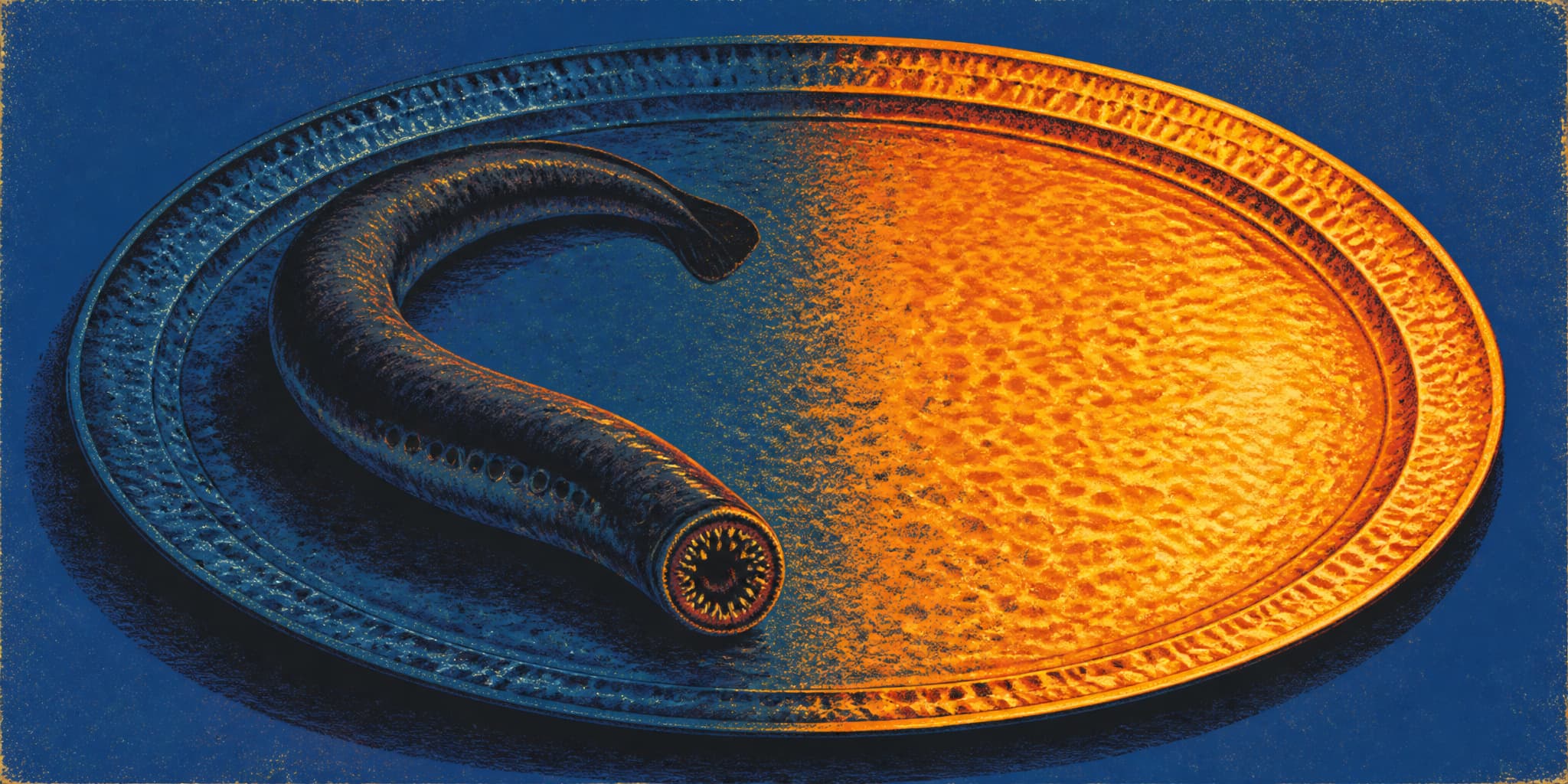
Cass opened the lid. The lamprey were wrapped in waxed cloth, dark and oily, the bodies curved into crescents the way they dry. Cass lifted one out. Long as a forearm, skin blackened from the smoke, the flesh under it dense. Tam caught the smell from where he sat, fatty and mineral.
Cass carried it up the table. Della was standing at the head. Alahmoot was standing at the side. Harlan had his eyes open again.
Cass set the lamprey on the tray. Off to one side. Leaving space.
It was the big tray, the one with the hammered edge somebody's grandmother had beaten out of a truck fender decades back, and the lamprey took up maybe a third. The rest was bare steel, polished, holding the light.
"The river sent this," Cass said. "It's first food. It's Clearwater. It was born here." Cass looked at Della. "The space is for the salmon. Salmon comes, salmon goes there. The record says lamprey present, salmon absent, space held. What the river sent and what the river owes."
Della looked at the tray a long moment. Then at Cass — twenty-six years old, wearing her daughter's mouth and her own hands, turning into something Della had not planned for and was not going to be able to steer.
"The space stays," Della said.
"The space stays."
Della nodded.
The ceremony went. Cass blessed the water and the pitchers went around. The lamprey was served out in pieces smaller than a finger, dark and heavy and so rich that people ate slowly without deciding to, and the oil stayed on their hands afterward through two rinses at Willa's bucket station. Then venison, then roots, then berries. The order held. Della ate her piece standing at the head of the table and looked at nobody while she chewed.
Dale was packing before the last song finished. His wife wrapped the leftover camas in cloth. Rae's son helped Willa's daughter stack pitchers. Harlan sat in his chair with his hands folded and his eyes shut and his lamprey eaten. Somebody would drive him home.
Tam was loading the truck when Alahmoot came around the tailgate. His two people were already in the cab with the engine running and the cooler between them, considerably lighter.
"Dworshak can produce spring Chinook if it has generation," Alahmoot said. "Two dams repaired. Hatchery at capacity by next spring."
"I heard you the first time."
"You heard me say it to Della. I'm saying it to you." He leaned on the truck bed. "Cass says the space is for salmon. I can fill the space. Translocation, same method as the lamprey — plant hatchery Chinook in the tributaries where the cold water holds. I need to know where the cold water is."
"I'll send the thermal profiles. General locations."
"General locations don't plant fish."
Tam opened the driver's door. The heat came out of the cab at him and the vinyl was too hot to sit on.
"You'll lose those coordinates anyway," Alahmoot said. "The procurement maps draw themselves. You're the one who showed me that — the transaction records, the delivery routes. Somebody finds the cold water the way they found the smallmouth. I'm asking to use it before somebody prices it."
Tam pulled a rag off the dash and laid it on the seat and got in.
"I'll send what Della asked me to present."
Alahmoot stepped back from the door. He looked at Tam the way he'd looked at the river that morning, reading the speed of what was moving underneath.
"Next spring," he said. "Chinook on the tray. Think about what that's worth."
He walked back to his truck. Tam sat with the engine off a moment and watched him pull out, then looked down the bank. Della was still at the table with her hand on the hammered edge of the tray. The space was there, bright steel in the mid-morning light, and Cass was stacking plates around it, working carefully, not touching it.
Tam started the truck and pulled onto the gravel with the drive in his shirt pocket, both versions, and in the mirror the gathering went small behind him — the dead cottonwoods, the living ones, the tables, the people, the river running low and fast below the cobble line where the water used to reach.
- Lamprey restoration in practice: A peer-reviewed study found that Nez Perce Tribe translocations of adult Pacific lamprey into Snake and Clearwater tributaries increased larval abundance and produced juveniles that successfully migrated to the Pacific, though the species' roughly thirteen-year life cycle means results unfold over decades.
- Spring Chinook timing variability: Idaho Fish and Game reported that the 2026 Clearwater spring Chinook run peaked in late April, declined rapidly, and failed to produce the late-season pulses that normally extend fishing opportunity — a season defined less by lateness than by absence.
- Columbia Basin water forecast: Washington's draft 2026 forecast projects greater summer and early-fall water-supply vulnerability by the mid-2040s, with more precipitation falling as rain, earlier snowmelt, and deeper aquifer decline risk.
- Dam operations and salmon: A federal judge's February 2026 order directed narrowly tailored spill changes at eight Columbia and Snake River dams to aid salmon passage, while navigation and power interests argued the operational changes could ripple through irrigation, rates, and infrastructure.
