The Bill Arrives — One Household Inside Virginia's Data Center Expansion


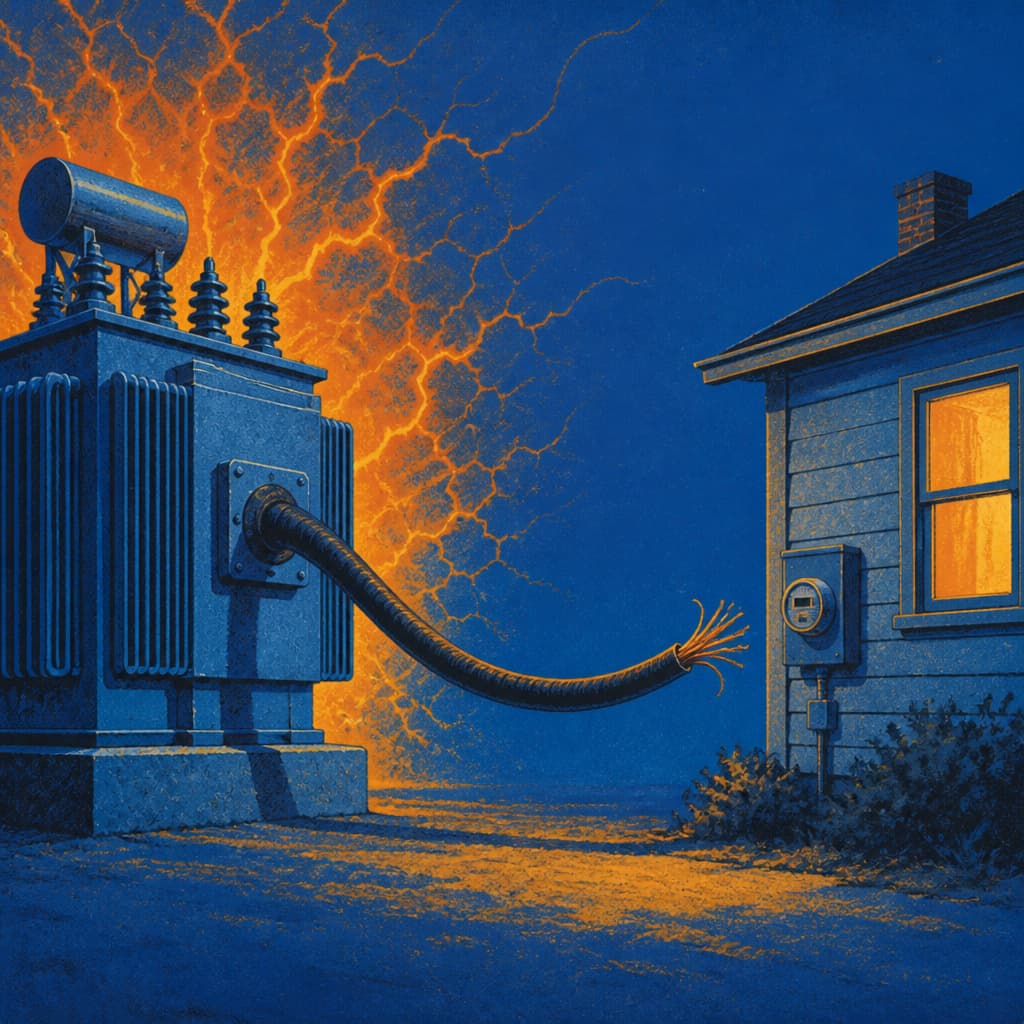
Vicky Hu bought her house in Ashburn, Virginia, for the trees. Twenty-five years later, Dominion Energy called to say a 185-foot transmission tower might go up 126 feet from her front door, to feed data centers that account for three-quarters of her county's personal-property tax revenue. She spent a year reading regulatory dockets, county budgets, and school board agendas, trying to find out who was responsible for what was about to happen to her property. What she learned is that the question doesn't fit on any of their forms.
The Bill Arrives — One Household Inside Virginia's Data Center Expansion
Vicky Hu bought her house in Ashburn, Virginia, for the trees. Twenty-five years later, Dominion Energy called to say a 185-foot transmission tower might go up 126 feet from her front door, to feed data centers that account for three-quarters of her county's personal-property tax revenue. She spent a year reading regulatory dockets, county budgets, and school board agendas, trying to find out who was responsible for what was about to happen to her property. What she learned is that the question doesn't fit on any of their forms.
Groundwater Reality

Two studies of Virginia's Coastal Plain aquifer system — one USGS (April), one DEQ (released in July, six months past its legislative deadline) — cover the same geology and reach compatible conclusions.
The USGS found that reduced pumping from 2010 to 2023 produced modest aquifer recovery across the coastal plain. But the deepest, most-tapped layer receives only about 7% of surface rainfall as recharge. Recovery was real and geologically slow, and per the DEQ study, it peaked around 2021. Regional declines are projected to resume within five to ten years at current pumping levels.
The DEQ study modeled what happens when a single large industrial user — 3 million gallons per day, roughly what a hyperscale data center running evaporative cooling requires — taps in east of I-95. It failed state permitting criteria at every location tested. The most favorable site could sustain 360,000 gallons daily. Near the I-95 corridor where data centers cluster: under 30,000.
Data centers currently account for under 0.5% of Virginia's statewide water withdrawals. Neither study identifies them as a driver of current aquifer conditions. The aquifer's problem is capacity, not blame: there is almost no room for new industrial withdrawals at the volumes being proposed.