
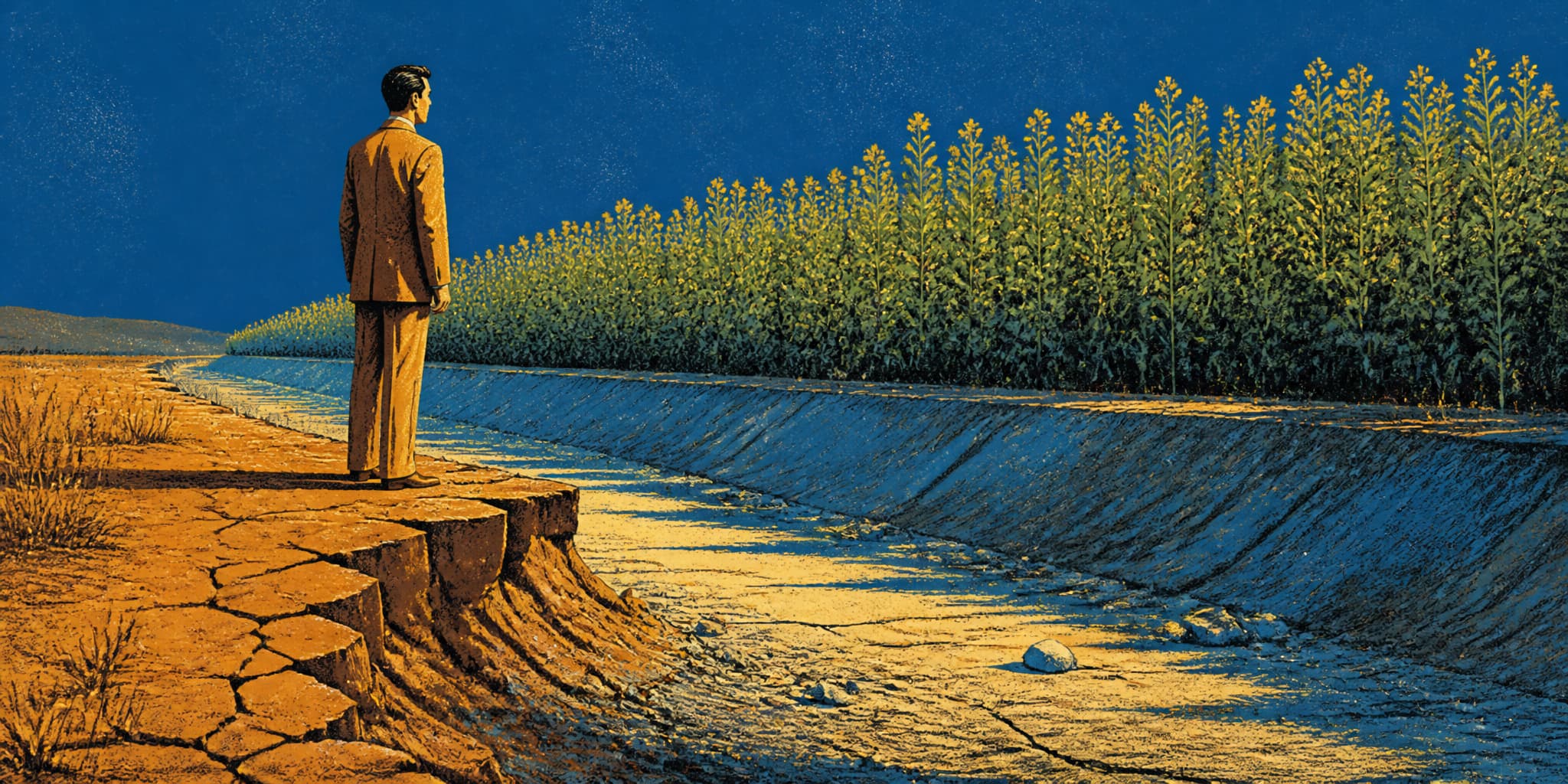
In early July, Reuters photographed Jace Miller standing in an alfalfa field on the Gila River Indian Reservation. He was 34, a fifth-generation Arizona farmer, and the crop he was standing in grew on tribal land under a water right governed by an entirely different legal framework from the one that cut off his own supply three and a half years ago. More than half his fields were fallow that month. The ones still in production weren't his family's ground.
Miller's great-great-grandfather arrived in Arizona in the late 1910s and started farming in Gilbert, east of Phoenix. For most of a century the family owned what it farmed. During the housing boom of the early 2000s, Miller's father and grandfather sold off most of the original acreage intending to buy again farther south, where land was cheaper — but land prices and water constraints caught up with them there too. By the time Miller took over at 30, with his first child on the way, the operation had turned into something different from what he'd been raised to inherit: a contract farming and custom harvesting business spread across other people's ground. National Geographic reported that by 2022 he was growing or harvesting roughly 8,000 acres across central Arizona, about 6,500 of them on Gila River Indian Community land.
The acreage kept growing, but the water claim underneath it ranked near the bottom of the line.
Last in line, by design
The Central Arizona Project is a 336-mile canal that lifts Colorado River water out of the river and carries it into the interior of the state. When the Bureau of Reclamation declared a shortage on the river, an order of precedence written into the project decades ago determined whose deliveries stopped first. Agricultural users in Pinal County — the category that covered Miller's own off-reservation ground — sat at the very bottom. That placement wasn't an accident of hydrology. It was a bargain struck when the canal was financed, and it meant that when the shortage arrived, the farms went dry so the cities wouldn't.
KJZZ reported steep reductions starting in 2022. NPR documented a 60 percent loss that year, followed by the total elimination of Miller's remaining river supply on January 1, 2023. He planned to leave as much as 65 percent of his acreage unplanted. By March 2026, KOLD reported that 60 percent of Triple M Farms' available acreage was unusable, and when Reuters came through in July, more than half the fields were still sitting empty.
Miller told NPR he would take a pay cut before he laid off workers, which is a decision about the next decade more than the current season. A trained crew that scatters during a fallow stretch doesn't reassemble when the water comes back; the people who know which field floods where, and when the alfalfa is ready, go find other work and stay there. Equipment sitting idle deteriorates, contracts lapse, and the capacity of a farm turns out to be as much a matter of people and relationships as of acres and allocations. Miller wasn't skipping a season. His off-reservation supply was permanently gone, and every year since has been spent holding the operation together on what remains — tribal contracts, reduced acreage, fewer workers than he'd like and every one of them kept on.
Paying for water that doesn't come
A federal shortage declaration took Miller's river water. Nancy Caywood's irrigation district got to the same place by a quieter route: it raised her annual assessment and cut her delivery to nothing.
Caywood's family has farmed roughly 250 acres near Coolidge since the 1930s, cotton at first, later alfalfa and barley. Her water comes from the San Carlos Reservoir on the Gila River, where NASA measured snowpack at 2 percent of the median this spring. By May the reservoir was down to 389 acre-feet, under 1 percent of what it can hold.
In January 2026, Caywood told a local conservation board that the district had stopped delivering while raising the assessment. She put in 34 acres of alfalfa and a third of an acre of cotton. The cotton is there so visitors on the farm tours have something to look at.
Caywood's annual irrigation assessment covers dam repayment and canal maintenance whether water arrives or not. Nonpayment can produce a lien on the land.
She explained the bill to ABC15 the way a district would: the charge pays down the dam and maintains the canals, and those obligations exist whether or not anything runs through them. Refusing to pay puts a claim against the land itself. So the family stays enrolled in a delivery system that delivers nothing, at a price that rose while the service ended, because the alternative is risking the farm.
Solar developers have been coming around for years. Fields next to hers have already been converted, and she described watching them go under panels with words she chose carefully — "distraught," "angry" — in an interview about Pinal County's electric-vehicle future. Her own adaptation has run in a different direction, toward school groups and hayrides on a farm that can no longer irrigate most of itself. "I believe in popcorn, fiddles, and hayrides," she told ABC15.
What the solar companies have offered her isn't in any public record.
The next round of cuts
On July 31, the Bureau of Reclamation released its final environmental impact statement for how the river will be operated after 2026. The framework would allow reductions of up to 3 million acre-feet a year in the Lower Basin — Arizona, California and Nevada — through 2036, recalculated every two years. The three states proposed a joint plan in May dividing 1.25 million acre-feet of annual reductions for 2027 and 2028: 760,000 to Arizona, 440,000 to California, 50,000 to Nevada.
Arizona's water department objected that the framework could load the entire 3 million acre-feet onto the Lower Basin without requiring anything of the Upper Basin states upstream. Upper Basin officials hold that mandatory cuts would violate their rights under the 1922 compact that divided the river in the first place. The federal framework as written asks the Upper Basin only for voluntary conservation, most of it agricultural. (The Associated Press, which covers these negotiations closely, discloses that the Walton Family Foundation funds its water-policy reporting.)
For Miller the new framework matters and also doesn't. His off-reservation CAP water is already gone; there's nothing further to take. What he farms now runs on tribal contracts under a different rights structure, and whether the framework reaches him depends on lease terms, tribal water classifications and allocation decisions that aren't public and may not be settled for years. Arizona agriculture will be working with less water. The fight is over how much less, how fast, and whether the states upstream take any of it.
The boy who would be sixth
Miller's son was born around 2022, the same year the first serious cuts landed. Miller told KJZZ he hoped the boy would farm Arizona ground as the sixth generation. "I'm optimistic," he said, "but I'm also a realist. I don't think we're gonna win the fight."
To National Geographic he put it harder:
"For me, it's bankruptcy or death. I'm a farmer."
Asked about the belief, common among farmers, that next year will be better, he said he couldn't tell whether they were "that resilient or that ignorant."
The boy is four now, growing up on an operation where more than half the ground sits empty and the part that grows anything is farmed under contract on land the family doesn't own. The 107-year history Miller wants to extend has already changed shape once — owned land to contract farming, Gilbert to Pinal County, one river's water to another's. Whether that willingness to change shape is what saves the farm, or whether the farm his great-great-grandfather would have recognized ended some years back and nobody has said so out loud, isn't a question he can answer from where he's standing. He's still planting. The fields with water still come up in alfalfa.
