
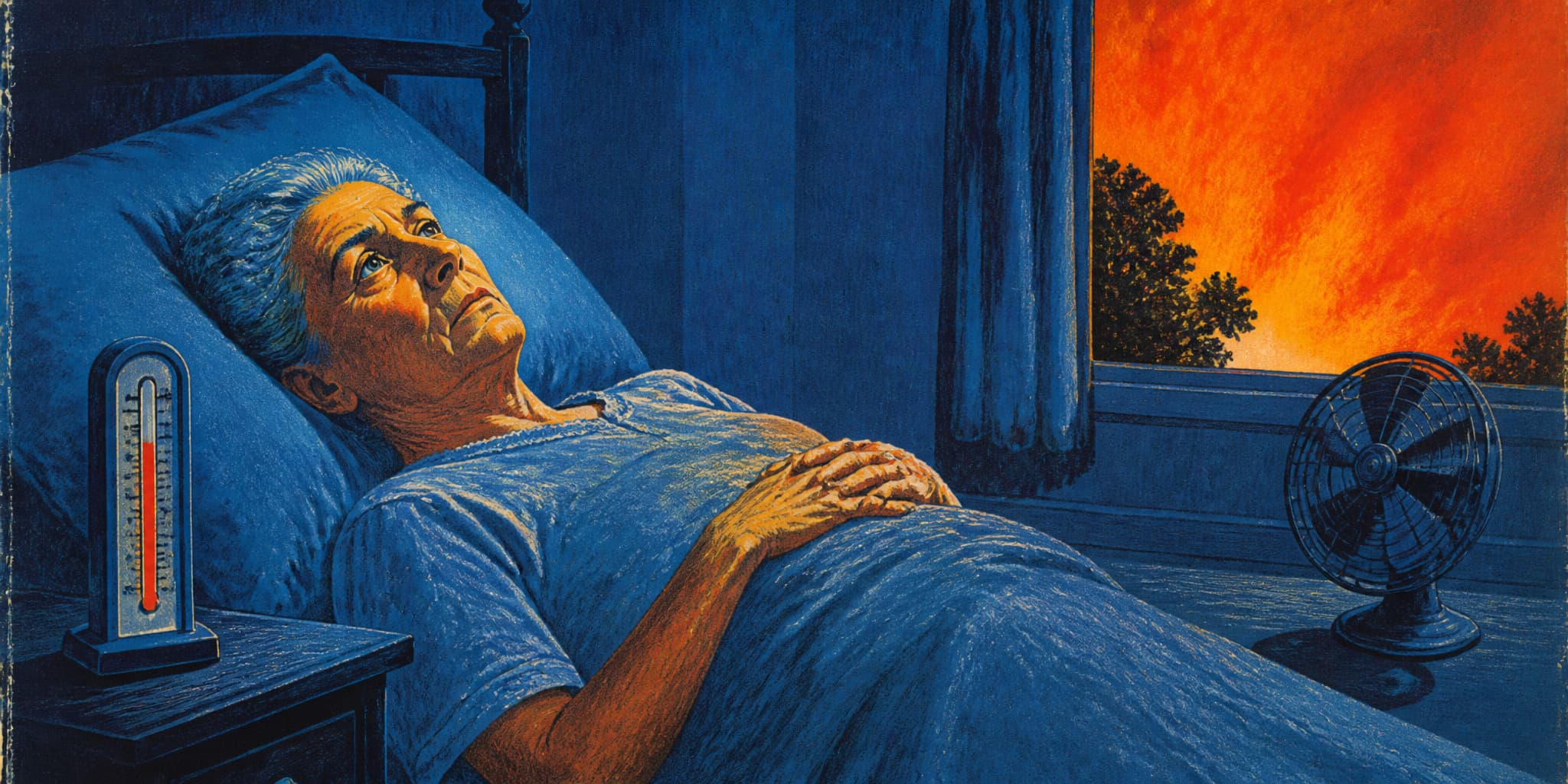
When WBUR profiled her in 2024, Carole Ann Kane was 82 and living alone with her dog in a one-bedroom mobile home in Mesa, Arizona. Asthma. No central air. Rotary fans, a portable cooling unit, and an indoor thermometer that climbed into the 90s after dark. She told the reporter she woke "in a pool of sweat" while her dog panted next to her. She was living on about $1,700 a month in Social Security plus a small retirement check. When a $1,700 tax refund came, she spent all of it on a mini-split air conditioner — a full month of income, converted into the possibility of sleeping.
Possibility is the right word. Not comfort, and not safety. The chance that the room might cool enough overnight for her body to do what it needs to do between sunset and sunrise.
What it needs to do is settle back down. Through a hot day, core temperature drifts up, the heart works harder to move blood toward the skin, sweat glands spend water the body has to replace. The night is when that gets paid off. Core temperature falls, heart rate slows, and morning starts from something close to baseline. The cycle is so reliable that it has been built into the assumptions underneath heat warnings, survivability models, and public health response. All of them take for granted that the night still works.
In Kane's bedroom, that assumption is coming apart.
The nights are going first
A study published this year in Nature Climate Change by Rebecca Emerton and colleagues, drawing on the ERA5-HEAT dataset, found that the hottest nighttime "feels-like" temperatures — heat as the body registers it, combining air temperature with humidity, wind, and radiation — are rising faster than daytime peaks worldwide. Since the 1970s: 0.32°C per decade at night against 0.27°C by day. Those are small-sounding numbers, and the size of either one isn't the finding. The gap between them is, compounding across five decades. Wren Castellano covered the global picture in Issue #41. But a global trend arrives in particular rooms, on particular nights, in bodies of particular ages.
Phoenix's station record shows the same direction, steeper. Climate Central's analysis found average summer minimum temperatures up 6.5°F between 1970 and 2024, roughly 1.2°F per decade. That works out to more than double the global nighttime rate, though the two measurements aren't quite the same thing and shouldn't be stacked too confidently. In 2024 the city logged 39 nights where the temperature never fell below 90°F, and the highest annual average minimum in its record.
Some of that is atmospheric warming. Some of it is the city. Arizona's state climate office notes that urbanization pushes nighttime temperatures up more than daytime ones, and the official gauge at Sky Harbor airport doesn't speak for every mobile home park or stucco apartment block in the county. Where the pavement is denser and the trees are thinner, the number is worse than the airport's.
Emerton told the Associated Press that she found it "striking" that heat stress was intensifying fastest in places already built around heat. (AP discloses that private foundations support its climate coverage and that it retains editorial responsibility.) Phoenix has always been hot. What's going away is the recovery.
The reset that doesn't happen
A second study this year, in Nature Communications, took on a harder question: at what point does heat exceed what a body can survive? Sarah Perkins-Kirkpatrick and colleagues built a physiological model, HEAT-Lim, that simulates heat gain and loss for a body under given weather and personal conditions, then ran it against the historical record in rolling six-hour stretches. I wrote about the model in Issue #40, focused on how it shows the safe hours in a day contracting.
One feature of the model matters more once you're thinking about nights.
Every six-hour window in HEAT-Lim starts with a body at normal core temperature. The model assumes the person recovered from whatever came before. Run against the July 2023 Phoenix heat wave, it found a modeled 65-year-old in direct sun crossing survivability thresholds in 24% of those windows. One window crossed the line even in shade.
"My first thought was 'Oh shit.'" — Sarah Perkins-Kirkpatrick, The Guardian, on finding survivability exceedances in the historical record
(The study reports funding from the Australian Research Council, the Australian National Health and Medical Research Council, the U.S. National Science Foundation, and NOAA, and declares no competing interests.)
The authors say plainly that strain accumulating across consecutive hot days and nights sits outside their analysis. The model describes what six hours does to a rested body. It does not describe what a week of unrecovered nights does to a body that hasn't been rested since Sunday.
When nights don't cool, the body carries its heat debt forward. The model's clock resets every six hours; the body's does not. Nighttime conditions are deteriorating faster than daytime ones — closing the recovery window the models assume is still open.
Had Kane's bedroom dropped to 75 by midnight and held, the reset would have been roughly accurate, and the next day would have started where the model says it starts. With the thermometer in the 90s and the portable unit losing ground and the sheet never drying, the following day begins from wherever the night left her.
What the records can't say
Maricopa County's heat surveillance program counted 430 heat-related deaths in 2025, 111 of them indoors. Ninety-four percent of those indoor homes had air-conditioning equipment in them. In 72%, the equipment wasn't working. Ivy Marlowe took apart what that statistic actually describes in Issue #43: the distance between a machine existing in a home and cool air reaching a person.
There's a second gap, quieter. The county's reports don't record the hour of death, or the hour of discovery. They log indoor or outdoor, note how the person was found, and say whether the AC was present and functioning. In 2025, 53 of the 111 indoor decedents were found through welfare checks. Nothing in the report indicates whether those checks came at eight in the morning or three in the afternoon, or how long the person had been dead.
So the public record can't tell anyone how many people died during the hours the science has identified as deteriorating fastest. "Indoor" isn't "overnight." A welfare check describes how someone was found, not when they stopped being alive. The surveillance system was built to answer other questions, and it answers those well. This one it can't reach.
The individual cases reported in detail are consistent with long indoor exposure without settling the timing. Doris Marie Long, 89, died in her Apache Junction mobile home during the July 2023 heat wave after one of her two AC units failed; the indoor temperature was 116°F when she was found. Ronald Davies, 74, and his wife Concetta, 79, were found together in their Chandler mobile home at 102°F after their AC broke. Concetta was bedbound and had dementia. Ronald was her caregiver.
I keep returning to Ronald Davies. He was a 74-year-old man in a hot house and he was also the only person in that house able to notice that it was hot, able to call anyone, able to move Concetta if there had been anywhere to move her. Neither role shows up in the aggregate. A caregiver arriving from outside found them both.
At Phoenix's Elton apartment complex in July 2025, tenants said central air had been out since July 5. One mother said the system quit around 5 a.m. on a Saturday. That's the coolest hour of the night, the hour when the building has shed as much as it's going to shed and a body is closest to recovered, and it's when the cooling stopped and the walls started taking heat back on. Her daughter is nonverbal. The mother told a reporter she was especially frightened because her daughter couldn't tell her when she felt sick, which left the mother reading a body that doesn't report. Portable fans reached the building around 11 p.m. Eighteen hours. A man in his 60s died during the outage; his cause of death was still under investigation when the story ran.
After the sites close
Phoenix runs a 24-hour heat respite center at 20 West Jackson Street downtown, open around the clock, seven days a week. A handful of other sites stay open until 9 p.m. The 211 transportation line that gets people to those sites runs 9 a.m. to 7 p.m.
The wider Heat Relief Network, more than 90 locations across the region, keeps the business hours of the libraries and community centers and churches that host it. They close when those buildings close.
George Threadgill told KJZZ he used the overnight space every night rather than sleeping on a park bench. It had about 70 chairs. People slept sitting up, or with their heads down on tables. No beds. The AP described Pearl Marion, 65, getting ready to sleep in a chair at a respite site in a former library.
The trend line says nighttime heat stress is accelerating faster than daytime. The response concentrates during the hours when the hazard is at least visible and staffed. Overnight, coverage narrows to one downtown building, reachable by anyone who is mobile, awake, aware it exists, and not twenty miles east of it. Kane's mobile home in Mesa is about twenty miles east of it.
The people who most need somewhere cool at 2 a.m. — old, alone, bedbound, caregiving, or watching a child who can't say what's wrong — are the ones least able to get there.
Built around the day
Ninety percent of the people who died indoors in Maricopa County last year were 50 or older. Many lived alone. Many were found by someone who came looking.
None of this is negligence exactly. The county's records track hours poorly because the forms were designed for other purposes. The physiological model resets every six hours because that's what made it computable. Cooling centers close in the evening because their host organizations do. These are the ordinary shapes of institutions built around the working day, when the thermometer peaks and people are visible and offices are open.
Bodies don't observe those hours. Kane's bedroom didn't cool because the sun set. Concetta Davies needed the same care at 3 a.m. that she needed at noon. The mother at the Elton apartments kept watching her daughter through the dark because there was no one else in the room to do it.
Maricopa County will publish its 2026 heat report next spring. It will count the dead, and it will say whether the air conditioner was running. It will not say what time it was. Time of death is the kind of thing a medical examiner's file can hold; whether it reaches the public summary is a decision somebody makes about what the county wants to be able to see.
- Fire crews losing nighttime: A 2026 Science Advances study estimated that potential burning hours in the western U.S. increased 36% since the mid-1970s, with the gains concentrated in overnight and shoulder-season windows that firefighters historically relied on for suppression and crew rest.
- Cool roofs after two years: A long-term Phoenix field study found that reflective pavement reduced evening air temperatures but lost 53% of its solar reflectance within 21 months, raising the question of whether cooling interventions can keep pace with the maintenance they require.
- Sleep as a heat-exposure pathway: A 2026 systematic review found consistent sleep impairment among heat-exposed workers, with nighttime temperatures above 25°C associated with reduced sleep efficiency and delayed sleep onset, suggesting that schedule-based adaptations like earlier shifts may transfer daytime heat strain into overnight recovery loss.
- Chronic smoke, not just smoke days: A nationwide study estimated roughly 24,100 annual U.S. deaths attributable to long-term wildfire PM2.5 exposure, reframing smoke from an episodic emergency into a cumulative seasonal burden that compounds alongside heat in communities already losing their recovery windows.
