
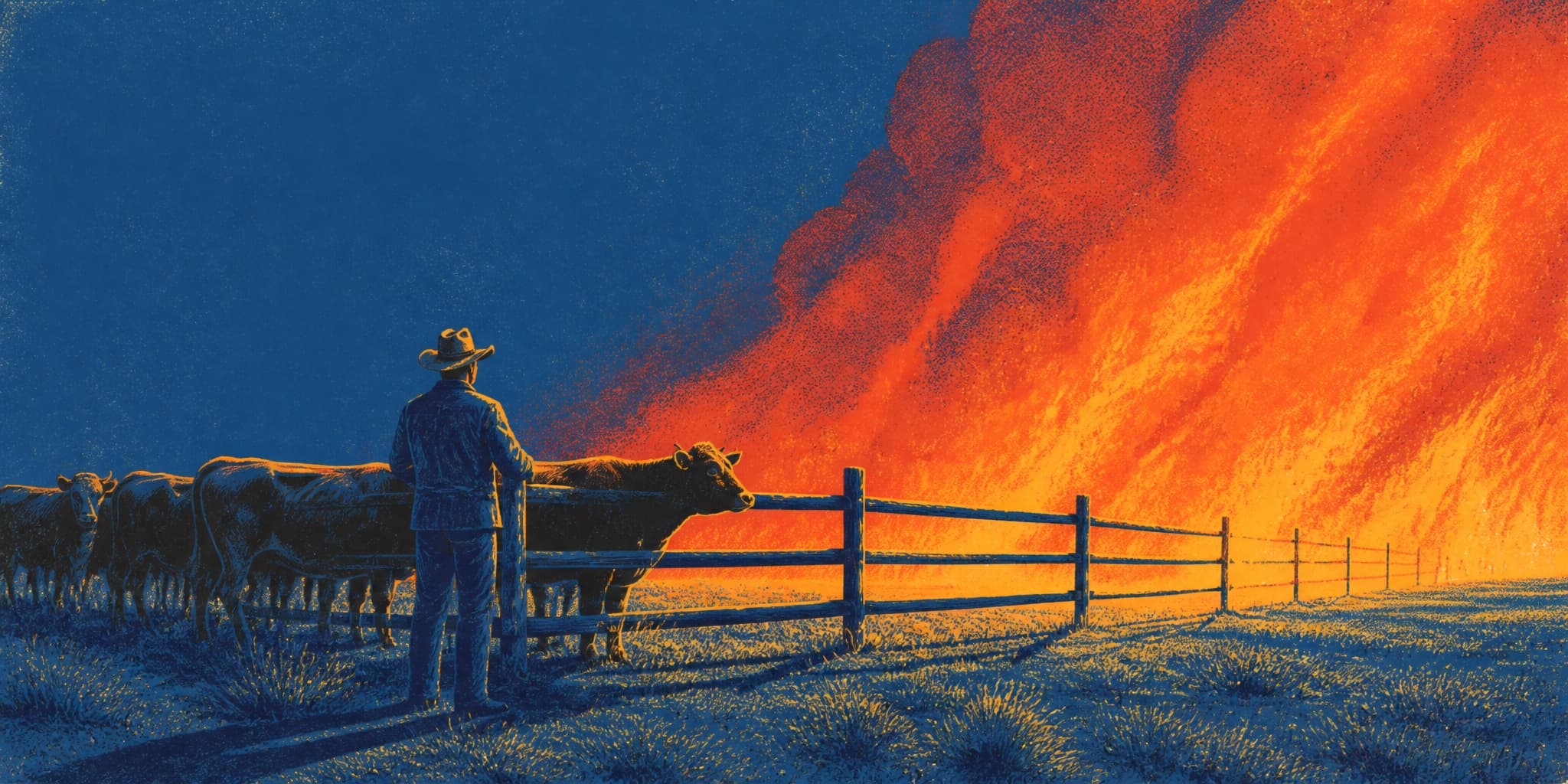
Brady Pearson usually plants two hundred acres of corn on his family's land near Loma, in Mesa County, Colorado. This summer he planted eighty.
The rest went to sorghum, which needs less water, or sat fallow. Unplanted ground holds moisture for the crops that stayed in. It also, as Pearson told Colorado Public Radio, frees up water "for our neighbors," who draw from the same delivery system. He's brought his cattle numbers down slightly. This fall, he plans to buy 50 to 60 percent fewer calves than in a normal year.
Follow any one of those decisions and it runs into the others. Less corn means less feed grown at home, which means buying more hay or running fewer animals, which means less income from Razor Creek Beef, the direct-to-consumer operation Pearson started in 2021, raising Sim-Angus cattle on land his family has farmed since 1898. Buying fewer calves this fall means fewer animals to work with next year. If any of those calves would have gone into his breeding herd, the reach is longer: a retained female typically has her first calf around age two, and rebuilding herd capacity after a reduction commonly takes most of a decade. The public reporting doesn't say whether Pearson's fall purchases include future breeding stock or animals raised strictly for beef. Either way, fewer calves is income and capacity he won't have.
Nothing burned on Pearson's property and nothing flooded. Mesa County is in extreme drought, and the accumulated weight of short water, expensive feed, and uncertain markets has him recalibrating the operation more or less continuously.
The water and the neighbors
In western Colorado, irrigators generally get water through ditch companies — cooperative organizations, some more than a century old, that run shared canals and the smaller channels called laterals, delivering to member farms according to shares and schedules. When supply drops, each user's decisions change what's left for the next one down the line.
The Grand Valley Water Users Association, which operates the Government Highline Canal and 150 miles of laterals serving more than 23,000 acres in the region, restricted all its properties to three-quarters of a cubic foot per second per 40 acres as of early August. The association had secured more than 38,000 acre-feet of storage to support 2026 deliveries, but the underlying supply is short. Whether Pearson's fields take GVWUA water specifically isn't publicly documented. The regional picture holds across Mesa County's irrigated agriculture: less water, same number of users.
Fallowing 120 acres so that neighbors have water is not only a crop calculation. It's 120 acres of corn he won't harvest, feed he won't grow, income he won't earn. Whether it's a formal water transfer, an informal accommodation within a shared ditch, or simply reduced demand that everybody on the system benefits from, the public reporting doesn't say. What's visible is that keeping his own operation going requires keeping the neighborhood going, and he's paying for that.
The hay
Hay prices, Pearson said, have more than doubled.
The USDA's Colorado hay reports offer thin but consistent confirmation. For the week ending August 14, 2026, the agency recorded a single confirmed trade in the mountains and northwest Colorado: 50 tons of fair-quality grass hay at $300 per ton. A comparable report from early August last year recorded one trade in the same category at $150 per ton. Two trades don't make a market average — USDA counts only confirmed transactions, not bids or offers — but they give a sense of what "more than doubled" means when you're buying feed by the ton to stand in for corn you couldn't plant.
An earlier piece in this section followed another western Colorado rancher, Robbie LeValley, through the same feed-cost pressure and the hard arithmetic of whether to sell breeding animals. Pearson is working a wider set of variables at once — water, crops, what he owes his neighbors, what he buys this fall — and each one moves the others.
The sorghum question
Pearson planted sorghum as a drought-tolerant substitute for corn, but the CPR reporting doesn't specify what kind: grain sorghum, forage sorghum, silage, or a hay-type variety. Those are different products with different markets and uses. Whether this sorghum is feed for his own cattle, a cash crop with a buyer lined up, or a bet that something would grow where corn couldn't isn't publicly documented. It's the sort of uncertainty Pearson is carrying himself. A crop that survives drought without a reliable market or an on-ranch use is a placeholder.
What's listed, what's usable
USDA lists a number of disaster programs available to Mesa County producers: the Livestock Forage Disaster Program, emergency feed assistance, livestock indemnity payments, emergency loans, crop insurance, conservation planning. Mesa County is a primary county in a 2026 fast-track drought designation, which lets eligible producers apply for emergency credit through December.
Each program carries its own eligibility rules, documentation, and deadlines. Applications for 2026 losses under the forage and emergency-assistance programs are due next March. Emergency loan applications close in December. Pearson is making calf-purchasing decisions this fall, months before some of those deadlines and long before any payment would arrive. Whether he's applied for any of them isn't in the public record. But sorting out which programs fit, gathering the paperwork, and judging whether the federal calendar lines up with decisions already locked in is work that runs alongside everything else, out of the same supply of hours.
The family has been on this land for 128 years and has come through bad years before. What 2026 is testing is how many times water, feed costs, herd math, crop markets, and obligations to the neighbors can be rearranged before the arrangements stop adding up to a working ranch.
