

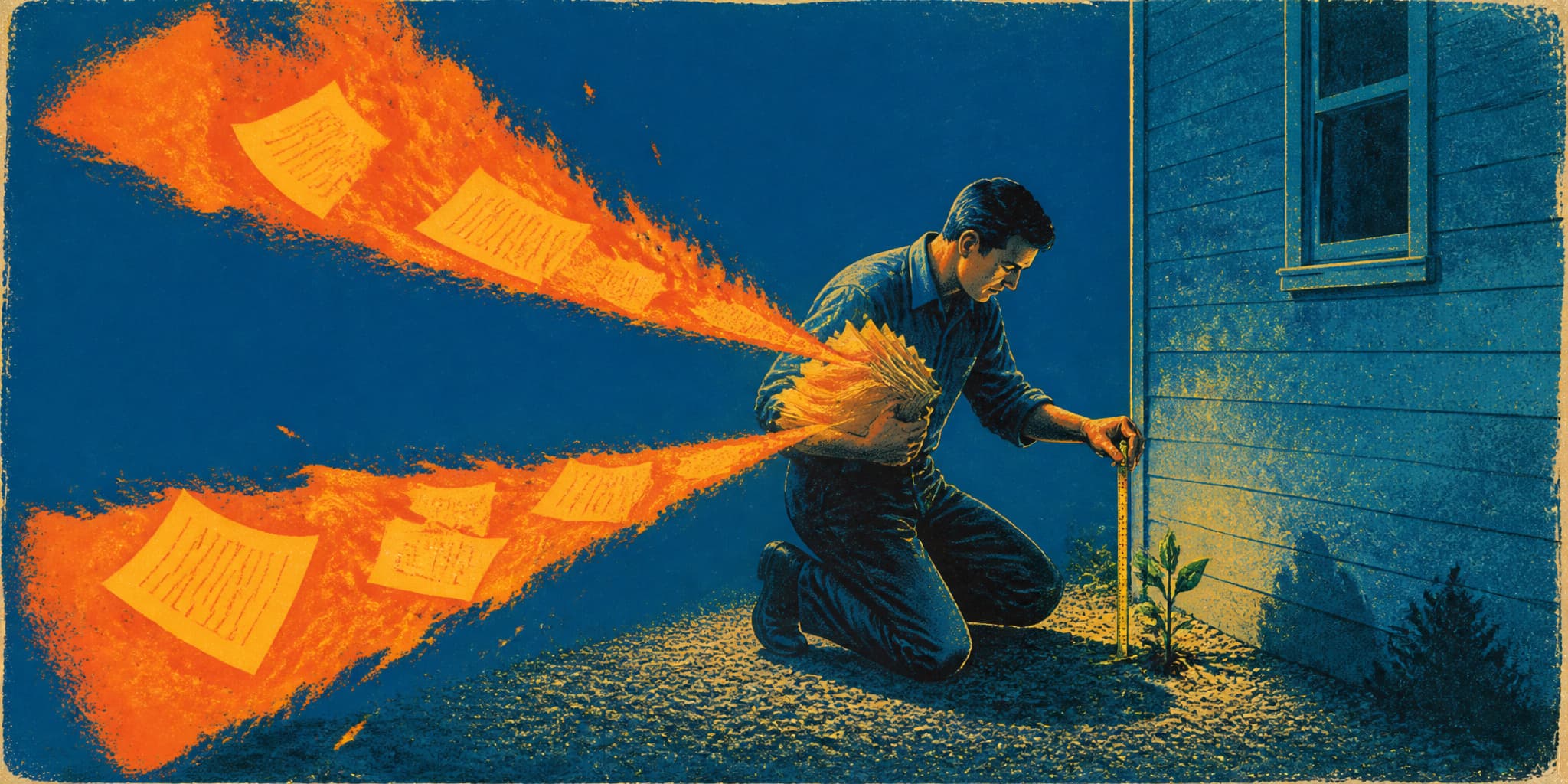
Most of this work happens on your knees. The Board of Forestry's Zone 0 regulation covers the first five feet out from the exterior walls of a house — or to the property line, if the property line comes first. Everything burnable comes out of that strip: leaves, needles, wood chips, the bark mulch somebody spread there years ago because it looked tidy and held moisture. Where it's packed against the foundation you pull it by hand. Then you measure a foot of bare ground out from every wall, farther where the eave projects. Groundcover in the rest of the zone stays under three inches. Anything taller survives only as an island of about a square foot, spaced from its neighbors by one and a half times the height of the tallest plant, which means you end up crouched beside a rosemary bush with a tape measure, doing arithmetic to decide whether it lives.
Dead branches come down. Live ones get cut back ten feet from the chimney and five feet above the roofline. A wooden fence attached to the house loses its first five feet, replaced with metal, masonry, or fiber cement. A small combustible shed inside the zone gets rebuilt in noncombustible materials or hauled away. You check whether the pots on the deck are noncombustible and under five gallons. You move the firewood off the garage wall, where it has been stacked for as long as you've owned the place.
The fire science behind this is not in dispute. What sits in the first five feet — where embers land, where radiant heat reaches siding — has an outsized effect on whether the structure is still standing afterward.
What the work costs is a separate question, and one the state has answered only partway. A 2024 Headwaters Economics study, supported by CAL FIRE and the Forest Service, put the price of converting the five-foot perimeter of a 1,000-square-foot house to pea gravel at roughly $2,782 in Northern California: about six cubic yards of gravel at three inches deep, plus demolition and labor. Swapping a wooden fence for fiber-cement panels on two sides ran $9,670. Those are 2023 numbers, and they don't include tree work, shed removal, drainage changes, or the weekends spent sorting out which plants pass. The Board's own emergency notice acknowledges the burden and phases compliance over three to five years for existing homes. Its fiscal analysis, though, is an analysis of costs to government agencies. What a household will spend — and which households can spend it — is not in the record.
The rule isn't in effect yet. The Board approved it; it's still sitting at the Office of Administrative Law, the state agency that reviews regulations before they become enforceable. For existing homeowners, the compliance clock hasn't started.
People in fire country are doing the work anyway. CAL FIRE recommends it. The local fire-safe council urges it. And they've seen what fire does to a house with mulch banked against the siding.
So the work is real. What happens when you try to make an insurance company acknowledge it?
What $5,800 Bought Ed Wong
In 2024, Sonoma County homeowner Ed Wong finished every upgrade his insurer, PURE Insurance, had asked for after inspecting his property — mandatory fixes to gas, plumbing, and security, plus two recommended improvements. Three years earlier he'd already put more than $2,000 into ember-resistant vents. The new round ran past $5,800.
He sent proof of completion on October 17, 2024. PURE's nonrenewal letter was dated the same day.
The letter cited wildfire considerations: distance to brush, fuel type, the size of the fuel expanse, access, community size, topography. Wong had spent his money on the things a person can change. The reasons given were the things a person cannot.
A California Department of Insurance spokesperson told the San Francisco Chronicle that the department would expect a nonrenewal to be reversed once a homeowner corrected the issues behind it. Wong said he never filed a complaint. His case predates the current Zone 0 rule, and it turns on structural hardening rather than five-foot clearance. But it puts a finger on a distinction that runs through the whole system.
Price Versus Offer
The Department of Insurance built a framework called Safer from Wildfires that names ten property-level mitigation measures — five for the area immediately around the house, five for the structure itself — along with community-level designations. Clearing the first five feet is one. Ember-resistant vents are another. A Class A fire-rated roof is another. Any of these that appears in an insurer's wildfire rating plan has to produce at least a $1 premium reduction. If the insurer wants an inspection to verify the work, it must accept one done by CAL FIRE or the local fire department.
That's the pricing side. Whether you are sold a policy in the first place is a different decision, made under different rules, and the department's guidance does not say that completing mitigation measures obliges any insurer to write or renew coverage. A carrier can count your cleared five feet in its premium calculation and still decline you over slope, wind exposure, road access, or how many policies it already carries within a few miles of your house.
Mitigation can move what you pay. It does not oblige anyone to sell you a policy.
Three Institutions, Three Proof Systems
A homeowner who does the physical work will meet three institutions. Each runs its own inspection, accepts its own paperwork, and moves on its own schedule.
CAL FIRE or the local fire authority can inspect the property and issue a defensible-space report. The current form is built for enforcement: it records violations, sets a deadline to fix them, schedules the reinspection. There's a box for "no violations observed," but the form predates the Zone 0 text and was never meant to be handed to an insurance company. Whether CAL FIRE will produce a dedicated Zone 0 compliance record is unresolved. And because the final rule lets local agencies adopt alternative practices, what counts as compliant can shift from one jurisdiction to the next.
A private insurer verifies mitigation through whatever process it has filed with the department. One Farmers Insurance filing calls for a signed checklist, photographs of each claimed item, and proof that the inspector is who they say they are — a business card, an invoice, company letterhead. If the insurer requires an inspection, it has to take CAL FIRE's. If it doesn't require one, it can verify however its filing permits: a questionnaire, a phone call, the homeowner's own word.
The FAIR Plan — California's insurer of last resort, now carrying nearly 700,000 policies — runs a process of its own. It exists for people the private market won't touch; it must write eligible properties and can't turn someone down for the neighborhood they live in or hazards outside their control. Applicants get a free inspection through the Plan's Inspection Bureau. The inspector looks at structural features, the condition of the building, and what surrounds it, and the Plan issues an action report: eligible, eligible after the listed improvements, or ineligible.
For policies effective November 2025 or later, the Plan offers up to 16.4% off the wildfire portion of the premium across twelve mitigation items. The public discount sheet doesn't say what documentation earns any of them. It tells policyholders to discuss proof and eligibility with their broker. Look for an upload portal, a standard certificate, a photo specification, an approved inspection vendor, or a way to contest a discount you think you've earned, and you won't find them published anywhere. So a homeowner sitting with a CAL FIRE defensible-space report in one hand and the FAIR Plan's discount schedule on the screen has nothing telling them whether the first document satisfies a single line of the second.
No one has tested it, either. The approved Zone 0 rule isn't operative, and the FAIR Plan's discount structure is less than a year old. That absence is itself worth naming: the path between these two institutions either hasn't been built or hasn't been made visible to the people who would have to walk it.
Who Carries the Translation?
In Washington state earlier this year, a homeowner who installed a 7,000-gallon water tank and arranged an 80,000-gallon suppression-water source with a neighbor was cancelled by way of a ZIP-code wildfire score that never looked at any of it. California has gone further than that; the Department of Insurance has built a framework that requires carriers to recognize mitigation when they set prices. The gap that remains is a gap because closing it is nobody's job.
The Board of Forestry writes fire-safety standards. It doesn't issue insurance certificates; insurance isn't its business. The Department of Insurance regulates how carriers price policies and makes them account for mitigation in their rating plans. It doesn't make them write the policy, because that decision belongs to the carrier. The FAIR Plan has to write eligible properties, and decides eligibility by its own inspection, its own criteria, its own calendar. Each mandate is complete on its own terms. What falls out is the handoff — one institution's output arriving as another institution's input — and no one is assigned to it.
The person with gravel where the mulch used to be is the only one who has to make all three of these agencies talk to each other.
When the Zone 0 rule takes effect it will give the state a single standard for the first five feet. A standard without portable proof — one inspection result that CAL FIRE, a private carrier, and the FAIR Plan all recognize — leaves that translation with the homeowner. For those currently shielded from nonrenewal by the Gann Fire moratorium, the translating has a deadline: August 6, 2027.
The Gann Fire Moratorium
On August 6, 2026, Governor Newsom declared a state of emergency over the Gann Fire. Eight days later, the Department of Insurance issued Bulletin 2026-6, activating the mandatory moratorium under Insurance Code §675.1.
What it does. It bars insurers — both state-licensed carriers and surplus-lines companies, which write coverage the licensed market won't — from cancelling or nonrenewing residential and certain commercial property policies "due to wildfire risk" in 22 ZIP codes across Calaveras, San Joaquin, Amador, Tuolumne, and Stanislaus counties. The department estimates more than 64,000 policyholders are protected. Covered residential policies include homeowners, condo-unit-owner, mobile-homeowner, and renter policies. The 2026 expansion also reaches commercial property policies for apartment complexes, HOAs, multifamily buildings with more than five units, senior living, and student housing.
What it doesn't do. Insurers can still cancel for willful or grossly negligent conduct that materially increases risk, for unrelated losses that make the property ineligible, or for post-disaster changes other than wildfire damage. Policies already nonrenewed before August 6 are not restored.
When it ends. The statute sets the period at one year from the emergency declaration: August 6, 2027. The insurance commissioner has no power to extend it. A separate wildfire with its own gubernatorial declaration would start a fresh one-year period, but only for the ZIP codes tied to that later fire. Homeowners who suffered a covered total loss have longer protections — at least two renewal periods and no less than 24 months.
What happens after. The public data say less than you'd want. During the 2019–2020 wildfire moratoria, insurer-initiated nonrenewals in protected ZIP codes fell 20%, against 2.5% in unprotected areas. After those moratoria expired in mid-to-late 2021, statewide FAIR Plan enrollment rose 11.5% in 2022 and 18.1% in 2023. The state doesn't follow individual moratorium-protected households through their first renewal after protection lapses. So we know nonrenewals were fewer while the moratoria held, and we know FAIR Plan enrollment kept climbing afterward. How many of those new FAIR Plan policyholders were households whose protection had just run out is not something the available numbers can tell us.
The moratorium freezes the current policy for a year. It doesn't change the slope, the fuel type, or how many policies the insurer already carries nearby. When it lifts, a homeowner's standing rests on the same factors as before, plus whatever mitigation they finished in the meantime — and whether their insurer's proof requirements have any way to see it.
- National insurance data incoming: The NAIC collected ZIP-code-level data on premiums, nonrenewals, deductibles, losses, and mitigation discounts from 2018 through 2025, with a public report targeted for early 2027 — the first dataset that could show whether mitigation discounts are actually reaching homeowners at scale.
- FAIR Plan keeps growing: California's insurer of last resort reported 696,562 policies and $768 billion in exposure as of June 2026, a 157% policy increase since September 2022, while Florida's Citizens has contracted sharply through a managed depopulation program — a reminder that residual-market counts reflect regulatory design as much as underlying hazard.
- Flood maps and missing coverage: After spring 2026 flooding around Black Lake, Michigan, AP found that homeowners in unmapped Presque Isle County had tried and failed to buy flood insurance even though their township participated in the National Flood Insurance Program — a parallel case of proof that doesn't travel between institutions.
- BRIC grants reopened, redesigned: FEMA's $1 billion mitigation grant round closed July 23 after a court-ordered reopening, but the new round removed hazard-mitigation planning support and prioritized construction-ready projects, raising the question of whether communities that most need infrastructure can assemble the applications to get it.