
The wells have been running for eleven days.
I check Well 4 first because it's on my way in. Tuesday, still dark, the pump house smelling like warm electrical and chlorine. Runtime counter reads 2,847 hours. I subtract yesterday's number, multiply by the rated flow, write it in the book. The tank came back to fourteen feet overnight, which means demand dropped after midnight the way it should. I stand there a minute and listen to the motor. It sounds right. I lock up and drive to the plant.
The surface side is quiet. Roughing filter drained, UV units off, the intake from Camas Creek closed since the fire. I walk past the filter gallery on my way to the control room. The media's still in the beds, wet from the last backwash before we shut down. Eleven days without water moving through it and the place smells different. Less like water, more like concrete and standing air.
The screens show what they've shown for eleven days. Wells running, storage holding, distribution pressure normal. I scroll through the overnight log. Nothing. The storm sampler at the intake is armed and waiting, and it'll pull bottles on its own if the turbidity crosses the threshold it's set for. The threshold hasn't been crossed because it hasn't rained.
The creek sonde is still transmitting from the bridge abutment two miles above the intake. Turbidity 1.2, pH 7.4, conductivity steady. We put a second one in above the burn scar after the fires in '28, when the state started funding post-fire monitoring for small systems. Both of them read clean. The numbers are fine. They've been fine. What they describe is base flow, springs and the last of the snowmelt moving down a channel that hasn't seen rain since before the fire.
I pull up the forecast on my phone. Thursday night into Friday. Sixty-five percent. Three-quarters of an inch. The models have been sliding it around for a week and now they're starting to agree with each other.
I load the bottles into the truck. The sterile ones from the lab with the thiosulfate already in them. A few plain ones for the creek. The fire-season kit rides on the passenger seat all summer now, acid-preserved bottles for metals, glass vials for organics, chain-of-custody forms in a folder. We restock it every May. I haven't opened it yet.
The distribution route takes about three hours. Eight stops this week, four routine and four I added after the switch. At each one I take the aerator off, run the cold tap five minutes, bring it down to a pencil stream, measure free chlorine with the colorimeter, write the number, fill the sterile bottle. Don't rinse it. Cap, label, cooler.
The chlorine's been running higher than it did on surface water. I'm getting 0.6, 0.7 at most stops. Before the switch it was 0.3 to 0.5. The residual holds longer in the mains now. It doesn't matter for compliance. It matters for taste.
Between stops I drive through town with the windows down. The smoke cleared four days ago but it's still sitting in certain pockets, between buildings, in the shade where the air doesn't move. A few houses on Elm have their purifiers going. You can hear them from the street. The sky is that washed-out blue that means the upper atmosphere hasn't finished clearing.
Mrs. Alderman called three times the first week. Swimming pool, she said. I told her the chlorine was within our operating range, which it was. I told her the well water has a slightly different mineral content, which it does. I told her it was safe. She called twice the second week. She hasn't called this week. I don't know if that means she got used to it or she's buying bottled.
At the hydrant by the elementary school I flush seven minutes instead of five, because the line is long and I want water that represents the system, not what's been sitting in a dead end. Chlorine reads 0.5. I fill the bottle, cap it, put it in the cooler. The school is closed for smoke assessment, same company that did it after '31, same protocol. Their van is the only vehicle in the lot. I stand there with the bottle in my hand and the hydrant running into the gutter and nobody around to see any of it.
After the route I drive up Camas Creek Road. This isn't on the schedule. Nobody asked me to do it. I've been going every few days since the fire.
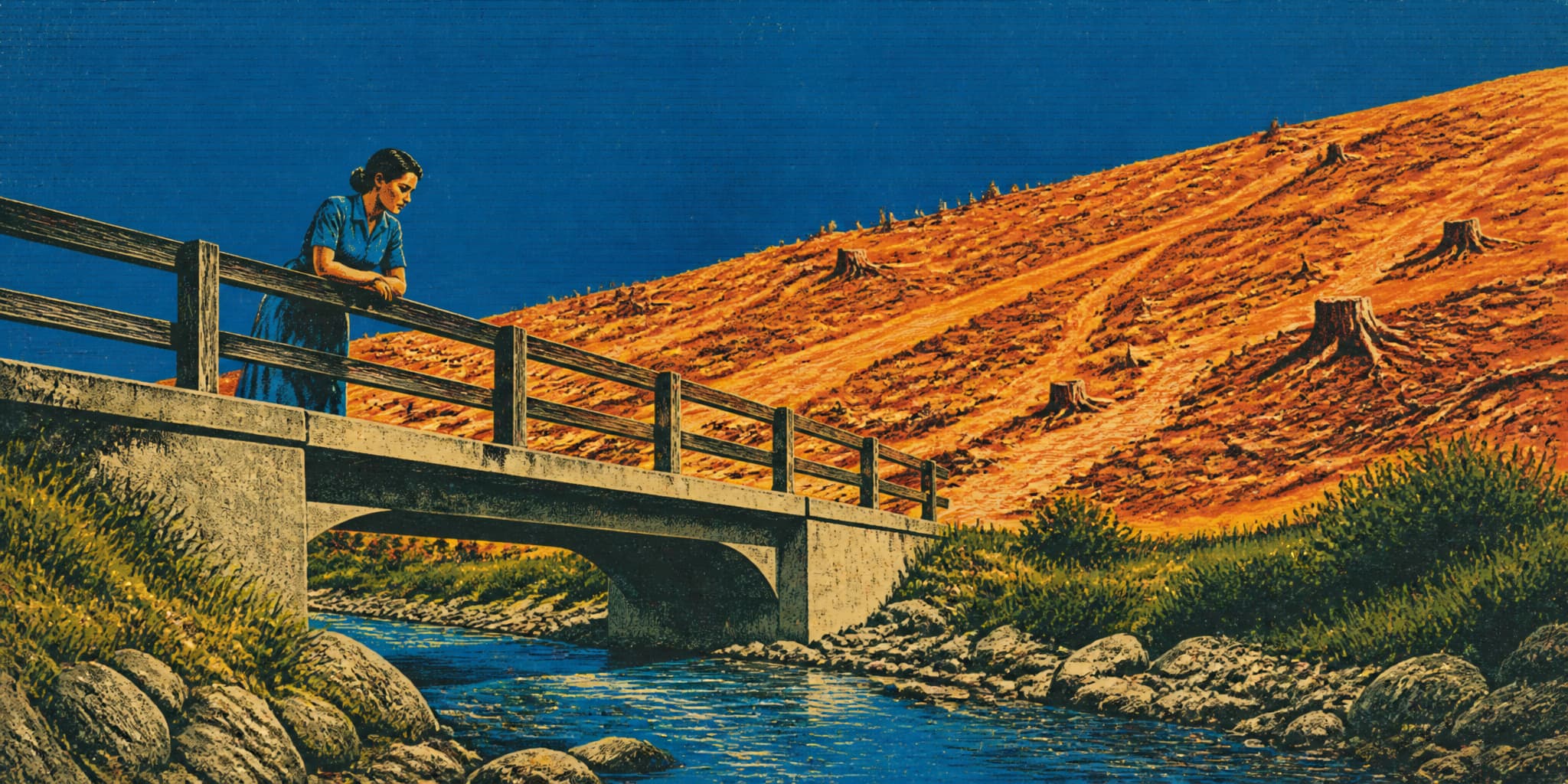
The creek is clear. It's been clear for eleven days. The water moves over the rocks the way it always has, and if you kept your eyes level you wouldn't know anything happened. The slopes above it are black from the waterline to the ridge. Mineral soil and char, nothing left on top of it. The trees still standing don't have needles. The ones that fell look like they'd come apart if you touched them. The ground in between is powder, and every gully and crease in that terrain runs downhill to the creek.
I stand on the bridge and check the sonde reading on my phone. 1.3. pH 7.4. A breeze comes up the canyon. Char, not smoke. The fire's been out two weeks and the slopes still smell like it happened yesterday.
I look at the water, then up at the slopes, then back at the water.
I know the order it happens in. The ash and sediment hit the creek within hours of a hard rain, and the sonde will show it before I could drive up here and see it for myself. The number goes from 1 or 2 to something I can't predict. Fifty. Two hundred. After the Cameron Peak fire in Colorado, intake readings ran past four hundred during the monsoon storms the following summer. Our creek is smaller and the burn scar is closer to the intake. I don't know what our number will be.
Then the rest of it, on different clocks. Dissolved organic carbon, which changes what the chlorine does downstream of it. Manganese, which the roughing filter wasn't built to handle and which, once it's into the equipment, tends to stay there. A small system in southern Oregon ran post-fire creek water through high-turbidity events a few years back and didn't sample for metals while it was happening. By the time they found the manganese it had coated the filter media, the UV sleeves, the sensors. It was already in the system.
None of that is in the water right now. The wells are clean. The distribution system is clean. The samples in my cooler will come back from the lab reading the same as they've read for eleven days. Safe. That's true. It's true about the water that's in the pipes today, which is the water people are drinking today, and that's the only water there is to test.
I drive back and log the samples. Enter the chlorine readings, print the chain-of-custody forms, pack the cooler for the courier. The office is quiet. The other operator is on vacation. We stagger time off during fire season so somebody's always here, which is how we've done it since '29. I eat lunch at my desk and watch the sonde update every fifteen minutes on the monitor. 1.2. 1.2. 1.3. 1.2. The building ticks in the heat. Out the window the sky is clear and the wind is from the south, which means the front is still out over the Pacific.
I open the well capacity spreadsheet I put together last week. Six wells, combined rated capacity around four million gallons a day. Summer demand runs two and a half. The math works. It doesn't say for how long. The aquifer isn't going to run dry. It's that the wells cost more to run than water that comes downhill on its own, and the water fund was thin before the fire, and sooner or later somebody on the council is going to want to know when we go back to the creek. That depends on the creek. The creek depends on the rain.
They asked about the timeline at last week's meeting. I told them what I could. The wells will run as long as we need them to, the water is safe, and the creek will tell us when it's ready. Councilwoman Briggs asked what ready meant in terms of months. I said I didn't know. She's asked that question after every fire since she got elected.
I check the sonde one more time. 1.2. Steady.
This is the second time I've done this. The Rattlesnake Complex in '31 took about a third of the upper watershed and we ran wells for six weeks while the creek cleared. That first rain was light, a quarter inch spread over two days, and the turbidity went to around forty and came back down inside a week. We got lucky with the weather. The slopes had time to settle before anything heavy landed on them. The burn scar this time is bigger. The forecast says three-quarters of an inch in maybe twelve hours.
After '31 we wrote a response plan. Revised it twice since then. Sonde thresholds that trigger a sample run, turbidity levels at the intake that mean we keep it closed, a decision tree for bringing the surface plant back online. The plan is sound. I helped write it. It describes a set of conditions and a set of responses, and if the conditions match the ones we imagined, the responses will work.
My neighbor Diane is watering her garden when I pull in. She waves. She used to ask me about the water every time she saw me. She stopped around day seven. Now she waves and goes back to the tomatoes. I don't know if she trusts the water or trusts me or has decided that asking doesn't change anything. She's using the hose. The tomatoes look good.
I eat dinner and wash the plate. The well water is harder than the creek water. More calcium. You can feel it on your hands, and the soap doesn't lather the same way. Eleven days and I'm used to it. Through the kitchen window I can see the hills to the west, the ones that didn't burn. They look the way they've always looked. You can't see the south hills from the kitchen. I've been eating in there.
Before bed I check the forecast again. Seventy percent now. The front is still offshore, still building. Radar shows clear sky over the whole basin. Out over the Pacific the moisture is coming together into something that will cross the Cascades and come down the east slope and fall on those black hillsides and run off them into the creek. When it does, the sonde will show it, and I'll drive up there with the kit and pull bottles out of water I've been picturing for eleven days. Send them to the lab and wait on numbers that describe what already happened. Five days for metals. Three for nutrients. Ten for organics.
The bottles are in the truck. The wells are running. With the bedroom window open I can hear Well 4, or not hear it exactly, feel it, a hum down in the ground.
I set the alarm for 5:30. The forecast won't have moved much by then. I'll look at it anyway.
-
Walla Walla's watershed fire: The Paradise Fire had burned more than 8,000 acres of Walla Walla's municipal watershed by late August 2026, prompting a governor's emergency declaration citing flood, debris-flow, and water-supply risks from burned slopes above the city's primary surface source.
-
What post-fire rain mobilizes: A 2025 study of tributaries after Colorado's Cameron Peak Fire found that different contaminants followed different transport pathways and timelines, with phosphate and ammonium spiking during summer storms while nitrate waited for the following spring's snowmelt.
-
Small systems, sparse data: After the 2020 Archie Creek Fire, Oakland, Oregon — population 934 — continued treating its creek water through high-turbidity events with only two early metals samples, and a subsequent EPA-supported review found manganese had accumulated throughout the plant's treatment equipment before anyone measured it.
-
Harder rain, drier ground: A 2026 Nature study found that increasingly concentrated precipitation can reduce annual land-water availability even when total rainfall stays the same, a pattern that makes post-fire runoff events more intense while the landscape between them grows drier.