The County Has Air Conditioning. The Room Does Not.

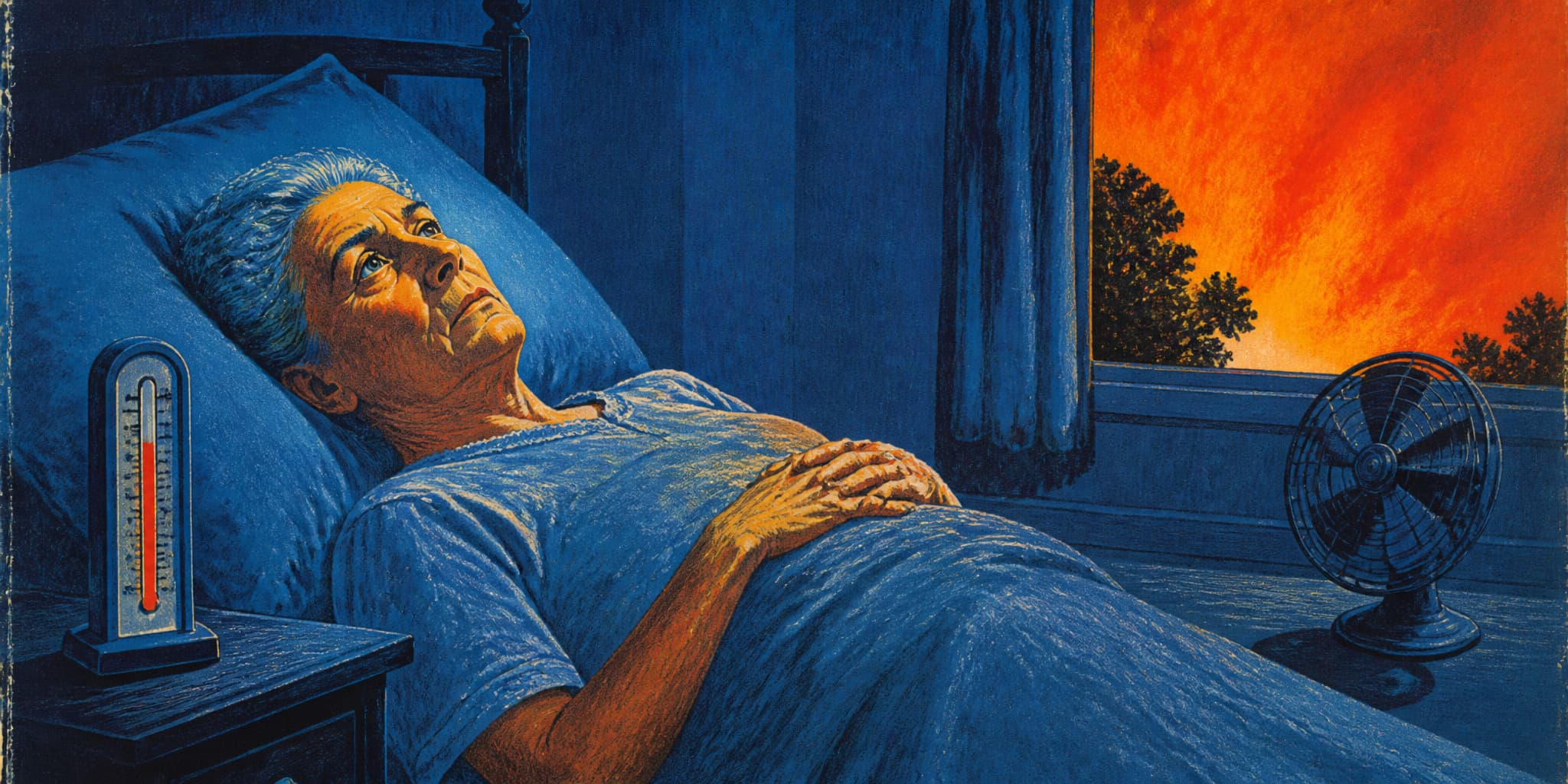
A study published this week in Nature Health estimates that residential air conditioning prevents more than 5,000 heat deaths a year in the United States, measuring cooling by county-level electricity consumption. In Maricopa County, Arizona, where nearly every home has AC equipment, 111 people died indoors of heat in 2025. Air conditioning was present in 94 percent of those homes. For a county statistic to become a person surviving a heat wave, a sequence has to hold: working equipment, an affordable bill, connected service, a cooled room that is the room where the person actually is. This piece follows that sequence.
The County Has Air Conditioning. The Room Does Not.
A study published this week in Nature Health estimates that residential air conditioning prevents more than 5,000 heat deaths a year in the United States, measuring cooling by county-level electricity consumption. In Maricopa County, Arizona, where nearly every home has AC equipment, 111 people died indoors of heat in 2025. Air conditioning was present in 94 percent of those homes. For a county statistic to become a person surviving a heat wave, a sequence has to hold: working equipment, an affordable bill, connected service, a cooled room that is the room where the person actually is. This piece follows that sequence.
Research Record
Nighttime Heat Stress Is Outpacing Daytime Warming Worldwide
Standard thermometer readings undercount perceived heat stress, which rises faster once humidity and radiant heat are factored in.
The stress thresholds were designed for daytime physiology, and the data reflects outdoor conditions—not what happens inside bedrooms.
Research Record
Dangerous Heat Hours Are Hiding on Days That Don't Count as "Hot"
Workers and vulnerable populations face heat exposure that daily maximums systematically miss, falling outside existing warning systems.
The headline numbers assume a high-emissions scenario, not a forecast, and omit indoor conditions and behavioral adaptation.
Research Record
Coastal Farms Defend Themselves Locally While Accelerating Regional Marsh Conversion
Local levees protecting individual farms may alter water movement and delay marsh migration at the regional scale, pitting neighbors against each other.
The study can't fully separate farming practices from the possibility that farms simply occupy the lowest, most flood-prone land.
Research Record
California's Land Retirement Plans May Carry a Valley Fever Tradeoff
California's groundwater law will pull vast acreage out of irrigation, potentially increasing dust-borne fungal spore exposure in nearby communities.
Cases map to home addresses, not infection sites—the study identifies statistical associations, not confirmed transmission pathways from specific fields.
The Scarce Hour

In a controlled heat study published this year, participants worked moderate-intensity shifts in hot conditions, took an hour-long break in a cool room, then returned to work. Their core temperature hit the occupational safety threshold faster in the afternoon. The break hadn't restored morning-level capacity. The heat was still in them.
A separate analysis of American time-use diaries (2003–2019) found the behavioral trace: on days reaching 100°F, workers logged 36% more non-work activity while at the workplace. The effect was sharpest among hourly workers and women, the people with least control over when they slow down and most scrutiny when they do.
The common adaptation advice is to start earlier, work before peak heat. But a morning hour claimed for outdoor labor is subtracted from sleep, from recovery, from the drive to drop children at school. A body that woke at 4 a.m. carries that deficit into the afternoon the same way it carries unresolved heat. The cool window shrinks, and everything that used to spread across the full day crowds into what remains.