
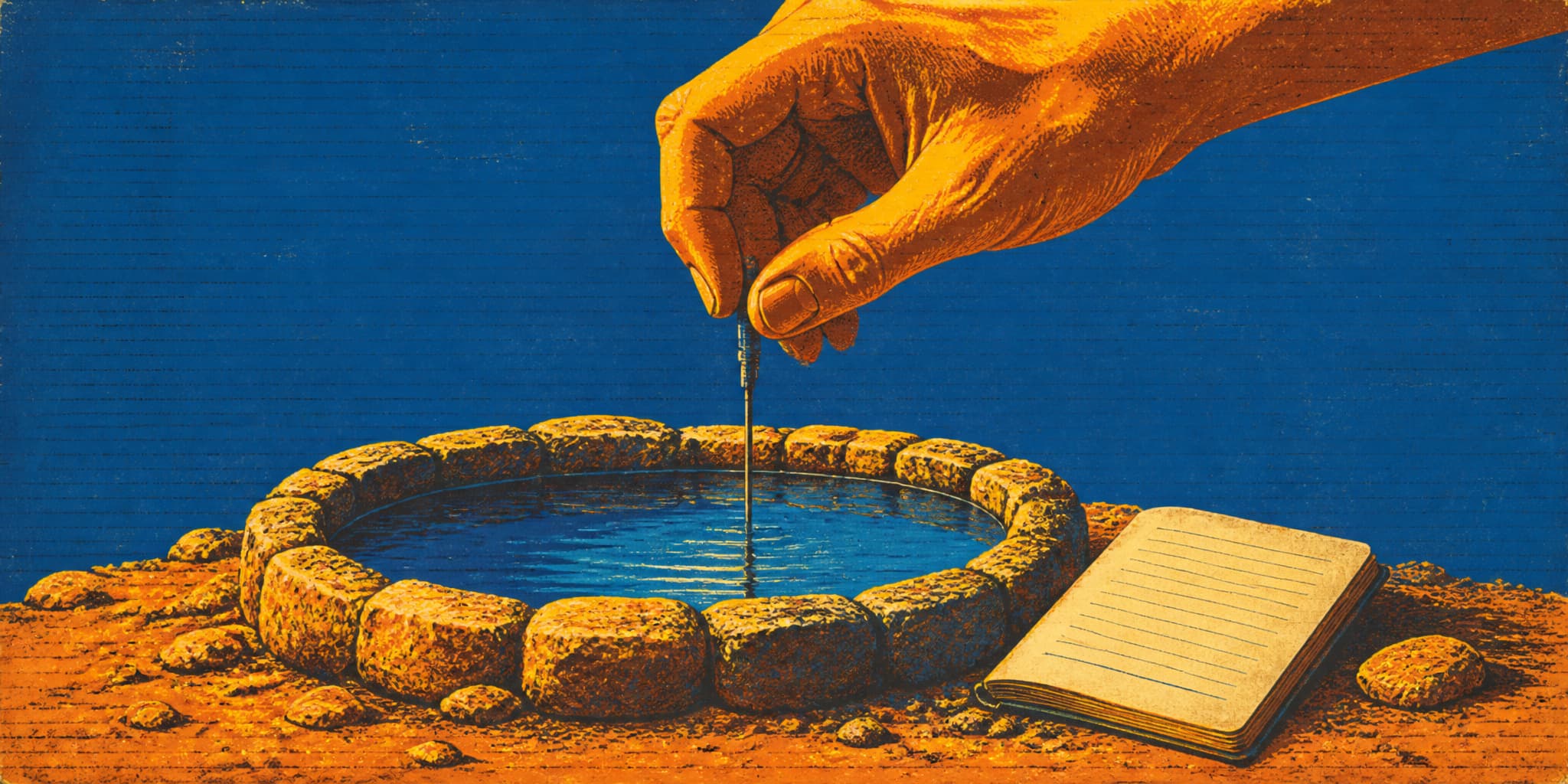
The logger read 11.3.
Tam kept the probe in the water another thirty seconds. The number didn't drift. He pulled it out, wiped the housing on his shirt, and checked the mainstem unit he'd staked six meters downstream. 26.8. Fifteen and a half degrees between the mud he was crouching in and the Grande Ronde, which was cooking everything still alive in it.
The seep came out of the basalt about a meter above the waterline, where two lava flows met. The upper flow was porous and crumbling along the contact. The lower one was dense, slick with a film of algae that had no business being green in August. Water collected in a channel no wider than his forearm and ran maybe twenty meters through mud and watercress and the roots of something he couldn't name, not willow, not cottonwood, something that had moved in after both of those quit. It entered the mainstem over a gravel lip barely covered by the current.
He stayed down there looking at the shrub longer than the data justified. He knew riparian species. He'd been trained on them, tested on them, spent years reading a streambank by what grew on it. Willow meant a shallow water table. Cottonwood meant seasonal flooding. Alder meant nitrogen. This thing had waxy leaves and reddish bark and a root structure that gripped the flow contact like it had been built for the slot, and it wasn't on any list he'd been given, and it was the healthiest plant on the bank. Two native species had abandoned the niche and something had walked into it while he was learning the old names. The field book had a column for riparian vegetation. He wrote unidentified woody shrub, vigorous, and looked at it a while longer before he went back to the water.
He'd almost walked past the seep entirely. From the bank trail the channel read as a mud seam between rocks. The thermal drone would have caught the plume where the cold met the warm, but he wasn't flying the drone today. Drone data went into the assessment record on its own, time-stamped and geotagged and sitting on the mesh relay before he could look at it. He hadn't decided yet what he wanted in the assessment record.
Tam pulled his boots off and waded in barefoot. The cold took his ankles and he swore at it, quietly, because after three hours in air that hadn't dropped below thirty-eight since mid-morning the sensation was sharp enough to feel like an error. The mud was soft and silty, ankle-deep in places. He moved slowly and watched the water ahead of him.
He found them in the deepest section, where the channel widened behind a half-submerged slab into a pool the size of a bathtub. Three juveniles, maybe four. Hard to count, because they scattered when his shadow crossed the water and then reassembled in the same spot within seconds, pulled back to whatever the cold was doing for them. Finger-length, dark-backed, faint parr marks along the flanks.
O. mykiss. He was sure of the species and nothing else.
The parr marks wouldn't tell him whether these were resident rainbow trout that would live and die in this channel or juvenile steelhead that would run to the ocean and come back, if anything came back. Same fish. Same markings at this age. Two entirely different futures, and the fish themselves might not have chosen yet. The river would choose for them, or the dams would, or the heat would, and none of those would consult his field book.
He crouched in the water and watched them hold against the faint current. Downstream the mainstem ran twenty-six, twenty-seven through the afternoon, past where a salmonid's metabolism starts shutting down. The seep was the reason these four were alive. The seep and however many others he hadn't found yet, spaced along the basalt contacts wherever the geology leaked.
He pulled out his field book, actual paper, because paper didn't sync, and wrote: Site 7. Basalt contact seep, east bank, ~20m channel. Bottom temp 11.3C, ambient 26.8C. 3-4 juv O. mykiss observed, parr marks present, life history undetermined. Pool depth ~0.3m, velocity negligible. Substrate silt/mud, some gravel at outflow. Overhead cover from unidentified riparian shrub, ~40% shade. Channel connected to mainstem at survey time but connection crest less than 5cm — vulnerable to further stage drop.
He did not write the coordinates.
Seven sites in four days. Three of them had fish. All three were spring-fed or groundwater-influenced, delivering water that had gone into the rock decades ago and hadn't heard anything about the last twenty years. The other four were cold and empty. He'd logged the temperatures anyway, because temperature was evidence of habitat, and habitat was what the assessment had asked for.
But habitat without fish was a different political object than habitat with fish. Della wanted fish. Proof the Snake populations were still working up into the Grande Ronde, still finding cold, still worth breaching the lower dams for. Alahmoot could take the same numbers and turn them the other way: if the fish were holding on in the seeps without anyone touching the dams, then repair the dams and give his people generation. Neither of them was lying about the data. The data didn't take sides.
What the data did, with coordinates attached, was make a map. In a basin where nearly everything else was too warm to hold anything alive, a map of the cold places was a map of the only ground left worth taking.
Tam put his boots back on and kept walking upstream.
The heat had gotten into the sorghum overnight. The leaf edges had gone pale and papery, curling inward the way sorghum does when it's trying to hold moisture against air that intends to take all of it. Fern pinched a leaf between her fingers. Still pliable at the base, still alive. The tips were finished. She'd lose maybe fifteen percent of the stand if this held through the week.
She'd been up since four, which was late for her, because she'd been patching the shade cloth over the amaranth until almost midnight and her hands were raw from the wire ties. The shade cloth was three materials stitched and wired together: old greenhouse film, a section of military camouflage netting she'd traded for at Pendleton two years back, and a panel of grass mat she'd woven herself that was already fraying. It covered about a third of the amaranth plot. The rest was on its own.
The spring was still running. That was the first thing she checked every morning, before anything else, the way you check whether the person sleeping next to you is still breathing. She walked to the head of the draw where the water came out of the hillside, seeping from a crumbled basalt face into a shallow basin she'd lined with flat stones. The flow was about what it had been yesterday. She couldn't measure it precisely. She had no instruments and didn't want any. But she'd been watching this spring for three years and knew its rhythms the way she knew the ache in her lower back that meant rain was two days out. Late summer it slowed. It always slowed. It had never stopped.
She filled two buckets and carried them down to the bean rows. The dryland beans were bred for exactly this, some variety that had come through the church network, originally out of Sonora or Chihuahua, seeds somebody's grandmother had carried through the last hundred years of getting hotter. They didn't need much water. But much and none were different quantities and the week was testing the distance between them.
Two strangers had come yesterday.
On foot, from the south. They'd appeared on the old ranch road that switchbacked up from the valley floor, a road she used maybe twice a year for hauling she couldn't manage on the trail. They'd stopped at the fence line, which was barely a fence, just a run of juniper posts with wire that had been there since the ranch days and half of it down. They'd stood there ten minutes. Looking at the draw. Looking at the garden. Looking at the spring.
Then they'd turned around and walked back down.
She hadn't talked to them. She'd been in the amaranth, fifty meters off, and by the time she straightened up they were already leaving. Two people, packs, no visible weapons. They moved like they knew where they were going, which meant somebody had told them about the draw, which meant the draw wasn't invisible anymore.
Fern watered the beans.
The garden ran about two hectares up a northeast-facing draw that caught morning sun and went into shade by early afternoon, the only orientation that worked now, because south-facing ground cooked. The spring came out near the top, ran through her beds in a series of shallow channels she'd dug and redug over three years, and collected in a lower basin where she grew watercress and kept a few crawdads that had shown up on their own and that she ate when there was nothing else. Below the basin the water sank back into the ground and disappeared. It never reached the Grande Ronde. That disappearance was part of why nobody had come looking.
She grew what the ground allowed. Grain sorghum in the sunnier sections, amaranth wherever she could get cloth over it, tepary beans and drought-adapted runners along the channels. Prickly pear on the dry margins, which she never watered and never worried about and which outproduced everything else she owned. A medicinal plot near the spring: yarrow, echinacea, a stand of desert willow she'd started from seed that was finally, in its third year, throwing flowers. She traded the medicinals through Reyes's network. The grain she kept.
Nobody had insured this ground since before she was born. No grid, no road grader, nobody coming if she broke a leg. The county had quit pretending to govern this valley a generation ago. The Forest Service still administered the hillside above her on paper, but the last ranger through had been running a fire survey two years back and hadn't come again.
Until two strangers stood at her fence line and looked at her spring the way you look at something that has a price on it.
Reyes heard about the Grande Ronde pocket three times in six days. Once was weather. Three times was a direction.
The first was at Anthony Lakes, swapping batteries with a church relay crew running the high circuit between the Elkhorns and the Strawberries. A young woman named Darcy, one of Sparrow's people, asked whether Reyes knew anything about spring-fed sites in the upper Grande Ronde that were still holding fish. The question sounded idle. Her eyes were doing something else. Reyes said she'd heard rumors and asked Darcy about the battery situation, which was always bad enough to change the subject.
Two days later, on the old forest road above Granite, a pair of Boone's outriders were camped at the junction. Reyes knew Keach and half-knew the younger one, a face from Pendleton she couldn't put a name to. Keach asked her over coffee that was mostly chicory and ambition whether she'd been through the Grande Ronde valley recently, and whether there was anything worth knowing about water sources up the draws. He asked it the way Boone's people asked everything, bluntly, with the implication that the answer was already known and the question was a courtesy they hadn't yet decided to stop extending.
"I've been through," Reyes said. "Water's where it always is. In the ground."
"Specifically."
"Specifically in the ground, Keach. You want me more specific than geology, you're going to need better coffee."
He let it go. The younger man watched her face the whole time she answered, and she felt that watching down the trail and into the next drainage.
The third came on the relay. A text routed through the church mesh from a node she didn't recognize, asking in the clipped syntax of someone paying by the character whether she could confirm the location of a perennial spring-fed tributary in the upper Grande Ronde basin referenced in a recent assessment filing. It didn't say which filing. It didn't say who wanted it.
She could guess where the filing came from. After the Toppenish session, Cass had pushed the whole Helen Reuben archive to Spalding and Toppenish in the same second, so nobody could claim the other side was holding out on them. It also meant every faction with relay access was now running the same thermal signatures against the same remote-sensing archive, looking for matches. Helen's Magpie Creek data showed what a spring-fed refuge looked like in the record. Anyone with the pattern could scan for its twins. The Grande Ronde was an obvious place to start. Salmon country, basalt, springs.
And Fern.
Reyes deleted the message, which didn't remove it from the relay's buffer but would slow down anyone trying to reconstruct her traffic. Then she sat on a rock above the old Sumpter dredge tailings, the long windrows of chewed river gravel the dredge had left behind a century and a half ago because nobody had ever come up with a reason to put them back, and turned the word confirm over a few times. Somebody already had the coordinates. What they wanted was a second voice saying yes.
Three vectors on one piece of ground inside a week.
She'd been routing through Fern's draw for two years, since she stumbled into the garden on a circuit that took her lower than usual after a washout closed the ridge trail. She'd kept it off her route maps and told nobody. In her own memory it was a waypoint for when she wanted fresh food and a night somewhere that felt like a person was paying attention to the ground instead of arguing about it. Fern had never asked her to keep quiet. The invisibility of that draw was so obviously the only thing protecting it that saying its name out loud would have felt like striking a match.
But she'd told Tam.
Six months ago, when he was ranging the Blues hunting cold-water data for the dam assessment. She told him because he was the one person she trusted to look at a spring and not turn it into a line item, and because his whole argument at Toppenish, fourteen data points and not one location, was the argument she'd have made herself if she'd had the training to make it.
She pulled out the relay unit, wrote four words, no location data, and sent it through a node she controlled.
They're asking about her.
Tam found the draw on his fifth day.
He knew roughly where to look because Reyes described things the way Reyes described everything, obliquely, with landmarks that only worked if you were standing in the right drainage facing the right direction at the right hour. Northeast draw, second ridge south of where the old ranch road crosses the creek that isn't a creek anymore. You'll smell the sorghum if the wind's right. He spent half a day on the wrong ridge before the wind came around and he caught it. Not sorghum exactly. The green humid smell of watered ground in a country where everything else was dry and brown and waiting.
The draw opened below him like a crease in the hillside. He could see the whole garden from up there: the shade cloth, the sorghum rows, the dark green lines of the water channels cutting through paler soil. Two hectares of it in a drainage where everything else had finished its year in June. The surrounding hills were cheatgrass and bare rock and the skeletons of junipers killed in a fire he could date by the weathering, eight years, maybe ten. The fire had converted the slopes. Bunchgrass to cheatgrass to continuous fine fuel to annual burn to the same thing again next year, the conversion working a little further uphill every season.
He saw the woman before she saw him, down in the lower garden, crouched over something near the collection basin with her back to the slope. Wide-brimmed hat, long-sleeved shirt that had been white once and was now the color of the soil she worked in. She moved with the economy of somebody who did this every day and had stopped thinking about the individual motions.
Tam came down the slope making noise. You didn't walk up on somebody in the gray zone without announcing yourself, and you announced yourself with your feet. A voice carried at distance could belong to anyone. Footsteps on loose rock had a cadence that said one person, no hurry, hands where you could see them.
She stood and turned when he was thirty meters out, and watched him come down the last of it and stop where the first irrigation channel crossed the trail.
"You're the one Reyes told me about," she said.
"Depends what she told you."
"That somebody was coming through who'd want to look at the spring. That I should let him look." She looked him over. "She didn't say you'd bring instruments."
The logger housing sat in the side pocket of his pack with the probe cables coiled on top, drying since the last site. He hadn't thought to put them away. Three seasons of walking creeks alone had made the pack invisible to him.
"I'm surveying cold-water sites in the basin," he said. "For the dam assessment."
"I know what the dam assessment is."
"Then you know why the cold-water data matters."
"I know why it matters to people downriver." She pulled off her gloves and tucked them into her belt. Her hands were dark with soil, the nails short and split. "What it does to the place the data comes from is a different question. Nobody downriver is asking that one."
Tam read the garden as watershed. Spring at the top of the draw. Channels distributing through the beds, hand-dug, following the contour with a precision that said she'd spent a season getting the grades right. Basin at the bottom. A gravity-fed irrigation network built out of local rock by one person, and it worked. The plants were stressed and they were alive, and they were alive because she'd worked out how to make a basalt seep feed a garden on ground that every institutional map in the basin listed as empty.
"Can I see the spring?" he asked.
She didn't answer. She walked to a junction where two channels met, crouched, and lifted a flat rock out of the lower one. Water shifted and filled the upper branch. She watched the flow for a few seconds, moved the rock a hand's width, set it back down. Thirty seconds, start to finish, and it had nothing to do with his question and everything to do with the fact that the garden needed tending whether or not a stranger was standing in it asking for things.
"Those two who came up the road," she said, still watching the water. "You know them?"
"No."
"But you know why they came."
"I can guess."
She stood and looked at him straight on. "If I show you the spring and you put a number on it, that number goes somewhere. Where."
"Wherever I send it."
"And where are you sending it?"
"That's what I'm trying to work out."
She held his eye a beat longer. Then she turned and went up the draw, and he followed.
The emergence was smaller than the sites he'd been surveying on the mainstem. The basalt face was maybe two meters across, the seep concentrated in a band where the upper flow's crumbling base met the dense interior of the one beneath it. The water came out at about the rate of a slow tap, collected in the stone basin she'd built, and went into the first channel.
Tam crouched and put his hand in the basin. Cold. He took out the logger without asking and held the probe under.
"Fourteen point two," he said.
"What's the river at?"
"Twenty-seven, last I checked. So you've got thirteen degrees here."
"It's a garden," she said.
He looked up. She had her arms crossed, watching the logger in his hand like it was something of hers he might break.
"It's both," he said. "That's the problem."
"It's a garden that works because nobody knows it's here." She dropped her arms and pointed down the draw. "Two strangers stood at my fence line three days ago. Just stood there. Looking. They didn't have to say anything."
Tam lifted the probe out of the water and held the unit in his hand without writing anything down. Fourteen point two, with a location on it, would be in Toppenish inside a week and in Spalding the same day. Every faction on the relay could scan for its shape.
"Reyes said I should let you decide," he said.
"Decide what."
"Whether this goes in the record."
Fern looked at the spring and the basin and the channels running down through her beds.
"You've got other sites," she said.
"Six with temperature. Three with fish."
"Send those."
"And this one?"
"This one doesn't exist."
Tam put the logger back in his pack. He looked at the channels dropping away downslope and asked the thing that had been building in him since the ridge. "How'd you get the grades right on these? The water barely loses velocity through the whole run. That's hard without a level."
Fern almost smiled. "I dug them wrong three times. First year everything pooled at the second bed and the bottom two rows got nothing, so I redug. Then it ran too fast and cut through the lower bank, so I redug again." She shrugged. "Gravity's patient. It'll keep showing you where you're wrong until you stop being wrong."
"Most engineers I know would kill for that error tolerance."
"Most engineers you know have budgets. I had a shovel and nowhere else to be."
He laughed. She looked at him a second longer than she needed to.
"The assessment needs biological evidence," he said. "Temperature on its own doesn't prove the fish are using the habitat. If I can put juveniles at the other sites, that's enough for Della's argument without this place."
"And if you can't?"
"Then the argument gets harder. But it gets harder somewhere else."
"Come back if you want," she said. "On foot. And leave the drone wherever you keep it."
Tam camped that night in a side canyon two drainages south, under a basalt overhang that held the day's heat and blocked the wind. He ate cold sorghum porridge out of his pack and opened the relay unit.
The assessment protocol Della had authorized called for coordinates on all surveyed habitat.
He entered the six sites with no fish. Full coordinates, full temperature, full habitat description. The three with juvenile O. mykiss got coordinates, temperatures, observations, and the note on life-history ambiguity he'd been writing at every site because it was true and because it was the only honest thing he could say about what he'd seen. He could not tell Della or Alahmoot or anybody else whether those fish were steelhead or rainbow. The parr marks were identical. The genetics were identical.
Nine sites.
He did not enter site seven.
Reyes's message was still sitting in the buffer. They're asking about her. He read it once more and sent the packet.
The hole would hold for exactly as long as it took somebody else to walk the same ground and find the same thing with less reason to leave it out. He had twelve kilometers of mainstem tomorrow, and the air would be over thirty-eight by nine.
Fern worked until the light was gone.
She finished the beans, checked the ties on the amaranth cloth, cut three prickly pear pads for tomorrow, and pulled a handful of yarrow from the medicinal plot to dry overnight. The same as any evening.
But she kept looking down the draw toward the old ranch road. Kept coming back to the logger in the water and the number on its little screen and the way he'd said thirteen degrees like he was reading off a chart she was on.
After dark she ate prickly pear and cold beans and sat by the basin listening to the water. It was a small sound, a continuous quiet movement she'd learned to hear below every other sound. If it changed she'd know. If it stopped she'd know, and by then it would be too late.
She stood up and walked down the draw in the dark, past the beans and the sorghum and the prickly pear, to the lower fence line where the old road met her ground. She could see it in the starlight, a pale seam cutting the hillside, switchbacking down to the valley floor. Anybody coming from the south would use it. The alternatives were loose basalt scree or two dry drainages steep enough to break an ankle in.
She started pulling posts.
Not all of them. The ones marking where the road entered the draw, the ones that said here is where somebody lives, here is where the ground changes from wild to tended. She pulled four and dragged them into the brush. She kicked dirt over the wire. She broke a dead juniper branch off and dragged it across the roadbed, scuffing out tracks that hadn't been made in years and still read as a road to anybody who knew what roads looked like.
It took an hour. When she finished, the road was still there, because you can't erase a road, but the place it entered the draw was gone. It looked like everything around it looked. Abandoned ground running out into brush and rock at the foot of a hill with nothing on it.
She walked back up and put her hand in the spring basin. The water was the same cold it had been at noon and would be the same in February, which was the entire reason any of this worked. She held on past the point where her fingers started to ache, then dried them on her shirt and went to feel along the shade cloth ties in the dark, looking for the ones that would go first.
- Cold water under hot rivers: A 2017 tribal fish commission survey documented 99 cold-water refuges in the Upper Grande Ronde basin, with spring-fed side channels running up to 23°F cooler than the adjacent river during summer low flow.
- River heat outlasts the air: A 2026 study in Nature Geoscience found that atmospheric-riverine compound heatwaves have roughly tripled since the 1980s, with river temperatures spiking further and dissolved oxygen dropping when air and water heat events overlap.
- Mapping what you want to protect: The Walla Walla Paradise Fire burned more than 8,000 acres of the city's municipal watershed by late August 2026, and the governor's emergency declaration centered not on current contamination but on what the first postfire rain might mobilize into a water system that wasn't designed for it.
- When disclosure changes who lives there: A 2026 NBER working paper found that homes labeled "extreme" flood risk on real-estate platforms sold at a 3.3% discount to buyers with lower average incomes, suggesting that better risk information can shift which households occupy exposed ground rather than simply improving decisions.