

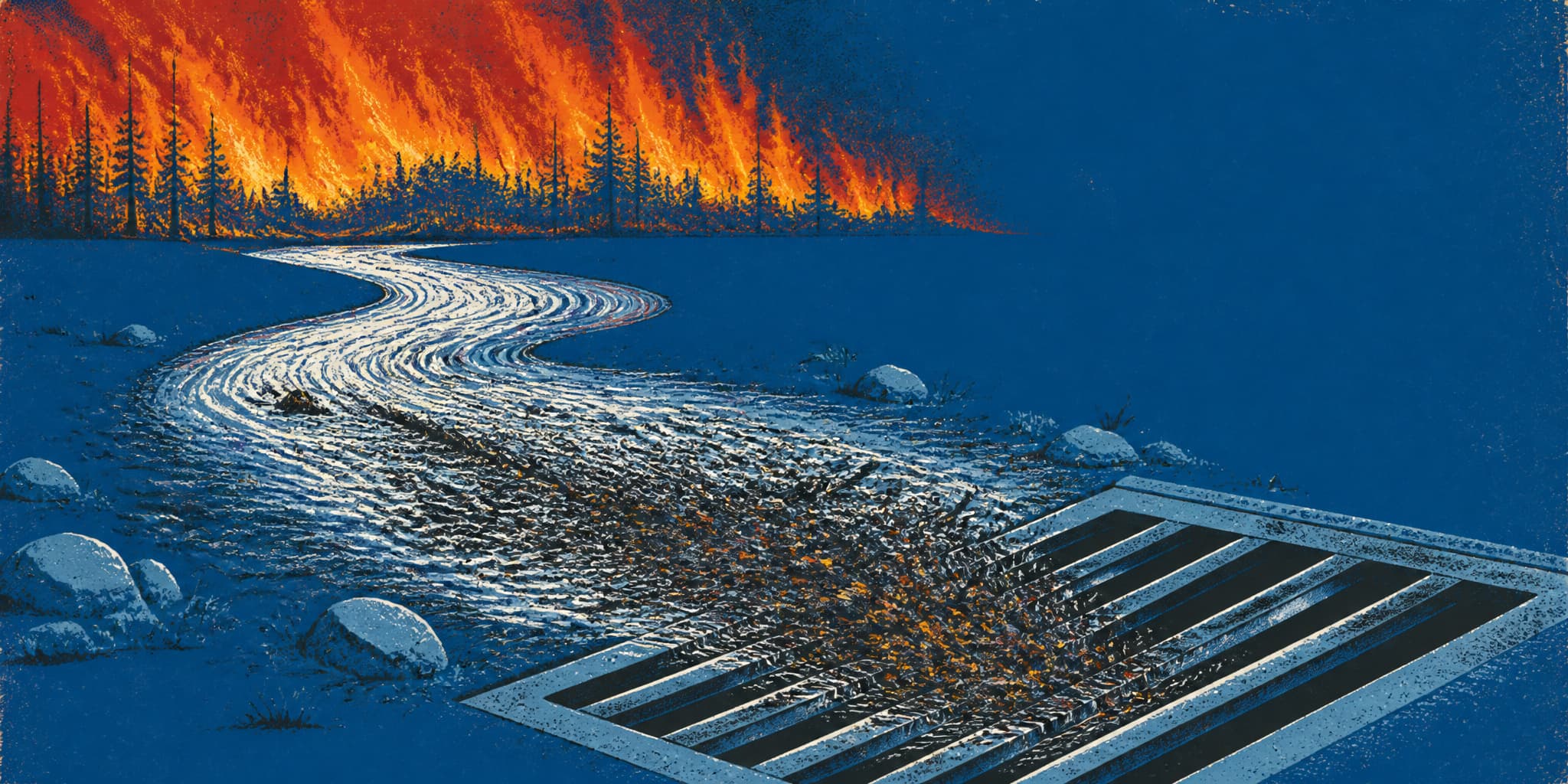
Mill Creek comes out of the Blue Mountains east of Walla Walla, Washington, and runs roughly fourteen and a half miles down to the city's water treatment plant. The Paradise Fire is burning up in that watershed, the city has been under an emergency declaration since late August, and the most recent water-quality tests show nothing wrong.
Those conditions have been sitting next to each other for weeks. What holds them apart is equipment and procedure: continuous monitoring instruments, treatment chemistry with known limits, seven groundwater wells in varying states of readiness, regulatory thresholds that trigger specific actions, and operators making calls about a situation the utility has said it hasn't managed before. The arrangement is stable right now. It hasn't yet been asked the question that matters, which is what Mill Creek looks like after the first serious rain over burned ground.
What the plant was built for
Walla Walla runs what regulators classify as an unfiltered surface-water system. That's a term of art, not a description of what happens to the water. It means the city met a set of federal criteria allowing it to skip conventional filtration: the multi-stage process where a plant doses incoming water with chemicals that make fine particles clump together, settles the clumps out in basins, and pushes what remains through sand beds.
What the plant has instead is a roughing filter of sand and gravel, ultraviolet reactors that inactivate parasites like Giardia and Cryptosporidium, chlorine for ongoing disinfection through the distribution pipes, and hydrogen peroxide for algae, which paired with the UV also functions as an advanced oxidation step. The city upgraded to UV in 2019.
The city's Water System Plan says the roughing filter was installed to improve operations during storm runoff and wildfire-related water-quality changes. Somebody looked at the forested watershed feeding the intake and planned for it sending down something ugly. That's real foresight, and it's also a filter sized for grit and coarse sediment rather than for dissolved organic carbon and fine ash, the fraction that stays suspended, passes through gravel, and then reacts with chlorine downstream. The treatment train handles what Mill Creek has delivered before, including its bad days.
To skip filtration, a utility has to demonstrate that its source is clean enough, consistently enough, over a long enough record. The waiver rests on that demonstration, which makes it a claim about the watershed as much as about the plant. The city's own August 27 bulletin stated the current problem precisely: the plant is "not designed to filter" the kind of water-quality changes a post-fire watershed can produce. Sustained loads of fine ash, dissolved organic carbon, and mobilized nutrients are what coagulation and filtration exist to remove, and those are the stages this plant was built without.
What they're watching
Turbidity is the workhorse number. It measures how much light suspended particles scatter as a sample passes through a beam; more material in the water, higher reading, reported in nephelometric turbidity units. Two thresholds govern operations. Source water above 1 NTU puts the plant on daily fecal-coliform sampling instead of the usual five days a week. Source water above 5 NTU breaches the ceiling attached to the system's unfiltered status.
An instrument reads the raw water around the clock, upstream of the first point where disinfectant is added, and those readings feed the calculation verifying the plant achieves its required pathogen-inactivation credit. Where the meter sits matters. It sees the creek before the treatment process does, and it produces a trend line rather than a snapshot, which is the difference between reacting and anticipating.
The city has described its fire response as "increased testing" and reported no fire-related effects on water quality. A regional report called the monitoring "more frequent and extensive" and quoted the public works spokesperson saying the utility was consulting state and federal guidance because it hadn't previously managed this situation.
What that consultation involves can be inferred from the guidance itself. The Washington Department of Health tells fire-affected utilities to prepare for erosion, turbidity, chemical mobilization, and solids-handling problems when major rainfall arrives. The EPA's wildfire incident checklist recommends a raw-water sampling plan, alternate-source preparation, upstream rain and sediment monitoring, verification of backup pumps and controls, and generator-fuel planning. For an unfiltered system there's a second layer to the stakes. If the source deteriorates past what the treatment train can handle, the utility has a water-quality problem and a permit problem simultaneously, and the second one doesn't clear when the water does.
The emergency sampling frequency, the full parameter list, the upstream sampling locations, and the lab turnaround times haven't been published. The baseline protocols set a floor: continuous turbidity, regular microbial sampling, quarterly organic carbon, annual inorganics. Whatever has been added above that floor isn't visible from outside. The proactive declaration, the agency consultation, and the willingness to say out loud that this is new territory describe an organization moving before the numbers force it to.
The switch
At some point, if conditions get bad enough, the city stops drawing from Mill Creek and runs on groundwater. The public description of that decision is qualitative. Surface water stays in service "until it no longer can be treated to meet Federal and State Drinking Water Standards." The city can also switch preemptively if fire retardant is dropped near the source.
No public document reviewed here names a numeric trigger that forces the switch automatically: not a turbidity reading, not an organic carbon concentration, not a manganese level. None names who makes the call, or whether the state Department of Health has to concur. The 2020 Water System Plan describes past turbidity episodes that took the surface supply offline, and notes that the city routinely suspends aquifer recharge during brief dirty-water periods and shifts to well recovery. So the mechanics aren't hypothetical. Operators have run this sequence, for shorter problems, and have the muscle memory for it. What isn't on the record is where the line sits when the dirty water doesn't stop coming.
An internal decision matrix may well exist. From outside, what's visible is the monitoring at one end and the outcome at the other, with the judgment between them unpublished.
The wells
Seven groundwater wells. The 2020 plan put their combined historical operating capacity at 24.6 million gallons per day against roughly 14 million gallons of daily demand reported during the fire, about 75 percent headroom. The August 27 bulletin said six wells were functional and capable of fully supplementing the surface supply. The city has also stated that groundwater and aquifer storage could meet all demand for at least ten years, a claim about the deep basalt aquifer rather than about pumping hardware. The bulletin didn't identify which well was out, or say what the remaining six produce together.
On August 20, a week before that bulletin, the city opened bidding for fixed emergency generators and automatic transfer switches at Wells 1 and 6. Bids are due September 24. Those two wells run the aquifer storage and recovery operation, where treated Mill Creek water gets injected underground during high flows for later withdrawal. As of September 3 the procurement remained open and the generators hadn't arrived.
The capital plan also schedules condition assessments for Wells 1 through 4 and flags Well 3 for rehabilitation: cleaning, controls, piping, roughly 4,500 feet of transmission main. Broader hazard-mitigation planning identified emergency power for all seven wells as an unmet need.
Maya Jiménez's "The Maintenance Cliff" in these pages examined how the interval between installing protective infrastructure and maintaining it produces a vulnerability that reads as readiness right up until the system is asked to perform. The Walla Walla wells are a mild version of that. The rehabilitation schedule and the generator purchase were already in motion before the fire started, which is what ordinary-time investment looks like. The fire arrived before the work finished. Six functional wells and a fully characterized, power-secured, capacity-tested backup supply are different things, and the difference only shows up when the backup is called on to perform.
What a burned watershed sends downstream
The water is clean because the fire hasn't sent anything down yet. Fire changes the ground; rain moves what the fire leaves behind.
Ash, exposed soil, burned organic matter, and metals freed from the soil column sit on the slopes until precipitation generates enough runoff to carry them into the drainage. Some rain has already fallen; an August 16 update reported thunderstorms that moderated fire behavior. A widespread, runoff-producing storm over the burned catchment hasn't been documented through September 3. The city's latest update mentions possible light, patchy showers, reports no new water-quality results, and notes no source switch.
When the real storm comes, the fourteen and a half miles turn into a clock. How much time operators get between rain hitting burned slopes and degraded water arriving at the intake depends on flow conditions, storm intensity, and how much of the burn drains straight into the mainstem versus feeding in through side tributaries. Since the plant already suspends recharge during brief turbidity spikes, the habit of watching for upstream dirty water exists. Whether a post-fire pulse gives operators hours or minutes, and whether the city would pre-position a source switch on a forecast rather than wait for the meter to move, the public record doesn't say.
The research on what happens after that first storm is extensive and doesn't agree with itself. A systematic review of 184 studies found increased suspended sediment or turbidity in 91 percent of reported observations, ranging from negligible to more than 25,000-fold, with a median around a thousandfold among affected watersheds. A 2025 analysis of 245 burned U.S. watersheds found organic carbon and phosphorus significantly elevated for one to five years, with some nitrogen and sediment effects running out to eight.
Read side by side, the two describe different worlds, and the difference is in what got counted. The review's 91 percent covers any measurable increase, trivial ones included, across individual observations. The 2025 analysis found statistically significant change in only 17 to 45 percent of basins for any given parameter, meaning most burned watersheds in that dataset produced no detectable signal for most contaminants. Both results can be correct. The disagreement isn't over whether fire can wreck a water supply; it can. The disagreement is over whether a particular watershed will, and the answer turns on burn severity, slope, soil type, geology, and rainfall timing in combinations that no model predicts reliably for a basin it hasn't studied. Anyone advising Walla Walla right now is working from probability distributions, not forecasts.
What makes those probabilities operationally specific here is the treatment gap. After Colorado's High Park Fire, storm-affected source water ran roughly tenfold above reference conditions for turbidity, nitrogen, and phosphorus. The utility's experimental treatment work found that several storm samples took heavy coagulant doses and still achieved less than 10 percent dissolved-organic-carbon removal. A Forest Service synthesis reported storm turbidity above 4,000 NTU in that watershed, close to a thousand times Walla Walla's 5-NTU ceiling. The Colorado utility closed the affected intake. That system had conventional filtration, the coagulation and settling and sand beds Walla Walla's plant was built without, and it closed the intake anyway.
Sediment isn't the whole problem, either. A California study found post-fire runoff raising dissolved organic carbon by 67 percent and dissolved organic nitrogen by 418 percent, and shifting disinfection byproducts toward more toxic brominated forms for up to two years. Disinfection byproducts form when chlorine reacts with dissolved organic material; they're regulated, and a plant makes more of them when the source carries more organic carbon. In New Mexico, dissolved manganese exceeded secondary drinking-water guidelines repeatedly for eighteen months after a fire. A gravel filter doesn't catch any of this, and the turbidity reading doesn't track it.
September 3
As of today the Washington Department of Health has issued no drinking-water alert for Walla Walla. The city declared its emergency early, consulted state and federal agencies, increased monitoring, kept the wells available, and told residents the water is safe. By every published measure, it is.
The same record shows what hasn't been settled. The plant lacks the stages that handle sustained post-fire sediment and organic loads. The backup carries documented gaps: the generator procurement for two key wells is still open, Well 3 is queued for rehabilitation, and the aquifer storage balance hasn't been published. The 1922 sluice structures at the Mill Creek intake, which the capital plan calls deteriorated and increasingly difficult to maintain, will handle whatever comes down the creek, because they're what's there. And the decision to switch sources, with no published numeric threshold behind it, will be made by operators under conditions the utility has acknowledged it hasn't encountered.
The tap works. The sampling continues, the bids close on the twenty-fourth, the wells stay ready, and up in the Blues the burned ground waits for rain it will no longer absorb the way it used to.
- Post-storm water results: The first significant runoff-producing rain over the burned Mill Creek catchment will test whether the city's treatment train and source-switch protocols hold, and the Washington Department of Health active-alerts page will be the first public signal if they don't.
- Generator procurement outcome: Bids for fixed emergency generators at Wells 1 and 6 are due September 24, and the city's open procurement will show whether backup power reaches the aquifer-storage wells before the wells are needed at full capacity.
- Multi-year contamination patterns: A 2025 analysis of 245 burned U.S. watersheds found organic carbon and phosphorus elevations lasting one to five years, meaning Walla Walla's water-quality challenge extends well past the fire's containment date.
- Treatment plant intake condition: The city's capital facilities plan identifies the 1922 Mill Creek sediment sluice structures as deteriorated, and the planned $3.23 million replacement project will determine whether the intake can handle post-fire flood flows and gravel loads.