

In September 2023, Tiffany Athy called a Lyft she couldn't afford and rode across North Philadelphia to pick up her son Ryan at Spring Garden School. The building had called an early dismissal because of heat. There was no midday bus. Athy is a single parent. "For single parents," she told WHYY, "we have to sacrifice work to be with our kids."
Sacrifice is the word people reach for when they'd rather not say the plainer thing, which is that somebody made a decision in an office and the bill arrived at her house. Athy's cost was at least countable in principle — a fare nobody recorded, part of a shift she didn't work. Same school, same afternoon, Leetonia Walton was absorbing a cost that doesn't fit on any receipt.
Walton collected her daughters Azariah and Mahala, and then she collected children belonging to other mothers who couldn't leave work. Her home became the after-school program. Nobody appointed her to it and nobody paid her. With no after-school care and no midday transportation, the arrangement organized itself the way these things do where people are short on options: whoever can be there takes the kids of whoever can't.
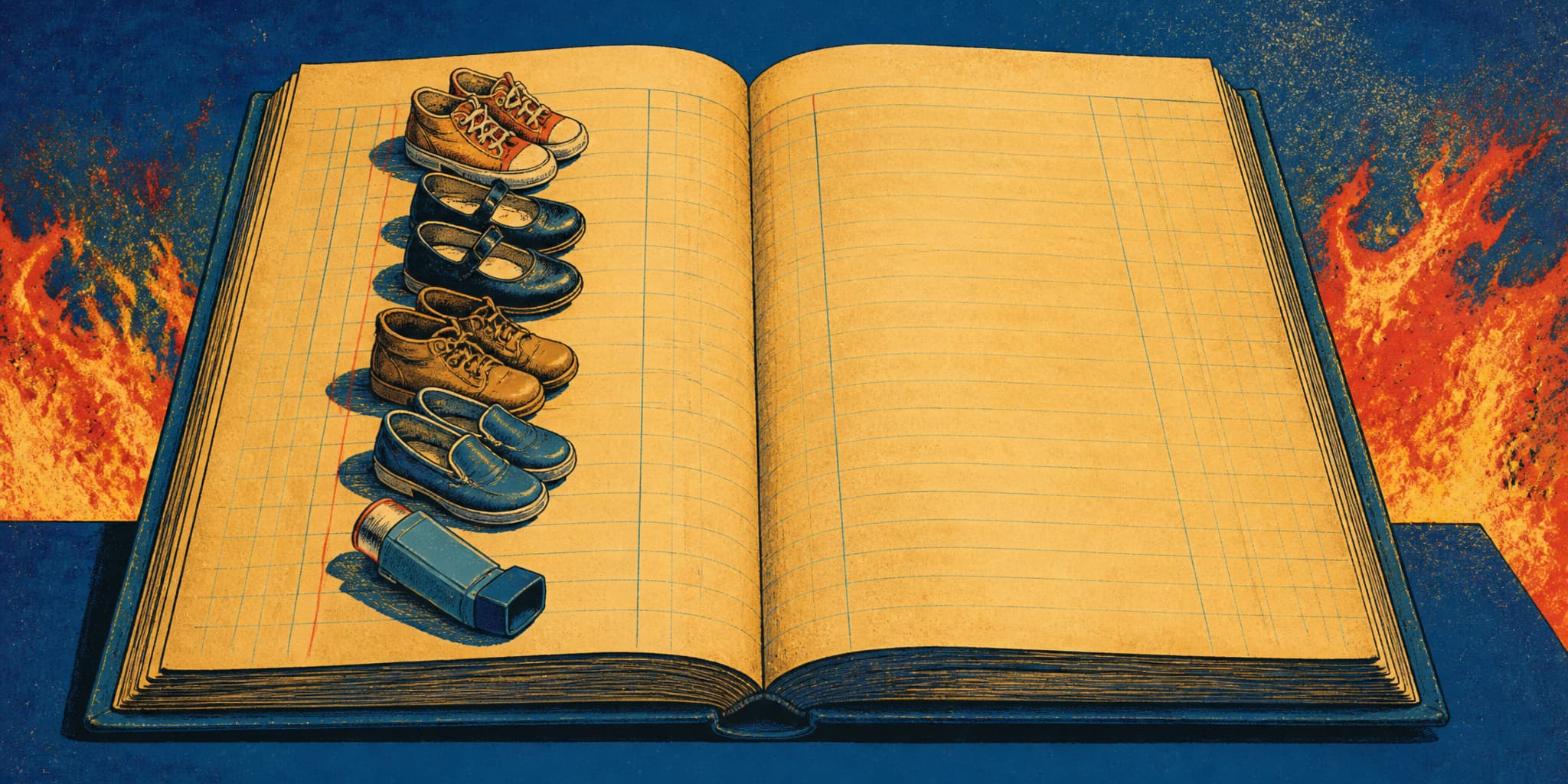
Her daughter Mahala has asthma, and heat is an asthma trigger, so the afternoon wasn't merely uncomfortable — it was something Walton had to actively manage. The school the children had just left had no central air conditioning, and WHYY reported most classrooms lacked window units. Whether Walton's home was any cooler is a question nobody in the public record thought to ask. What we know is that she had an asthmatic child and a houseful of other people's kids on a day the city had crossed the district's threshold for sending children home, and she was handling it with whatever she had in the house.
Almost everything else is missing. How many children ended up there. What she fed them. Whether she had air conditioning, or fans, or just open windows. What the electricity cost. How long the other mothers' shifts ran before somebody came to collect. Whether Walton had given up her own work hours to be available. None of it was recorded, because none of it is visible to the institution that set the afternoon in motion. Children were in hot classrooms; the district moved them out; once they cleared the doors, the district's information about them stopped.
The call
Spring Garden is one of 52 Philadelphia schools that dismiss early or go remote when the forecast hits 85 degrees by noon. The number moves around — 63 schools dismissed early in August 2024, 57 went remote one day in May 2026, with the district not explaining the extra five — but the mechanism doesn't. The buildings can't be cooled. Eighty-five degrees is not a freak event in Philadelphia between May and October. It is a warm day. The district's answer to a warm day in these buildings is to send the children somewhere else.
For a household like Walton's, the timing of the decision matters more than it does for most. The superintendent can make the call by 8 p.m. the night before, with families notified by nine. Or the call comes at 4:30 in the morning and the phones start at 4:45. If you're the person other parents are counting on to be home when their kids turn up at your door, that's the difference between clearing the living room and stocking the kitchen the night before and finding out at dawn that eight children are coming.
An early dismissal means district buses shift their schedules. A full remote day means the buses don't run. The child stays home with a Chromebook and does what Pennsylvania calls a Flexible Instructional Day — the state allows five a year, and the flexibility in question belongs to the calendar, not to anybody's schedule. Spring Garden's public pages don't specify how many hours of live instruction a first-grader gets on one of those days, whether attendance is tracked in real time, or what happens when the internet drops. The protocol says nothing at all about who watches a seven-year-old work through it while the parent is at a job. In Walton's neighborhood the answer was Walton, supervising her own daughters' schoolwork and minding other families' children and keeping an ear on Mahala's breathing in a room whose temperature nobody measured.
How often
During the 2025–26 school year, 57 schools went remote on May 20, the standard 52 went remote on June 5, and those 52 dismissed early on June 11. This school year they dismissed early on September 1 and again today, September 3. Twice in the first three days of the term.
Five heat-disrupted days in four months, and at each of those schools some version of Walton's afternoon happened. A living room filled with other people's children. A parent called a car she couldn't afford or walked off a shift. A kid with bad lungs sat in a room that may or may not have been cooled, managed by whoever was home, and nobody from the district was there to see any of it.
Ray Dutton, whose child was in third grade at Spring Garden, told CBS during an August 2024 dismissal that families had become "accustomed" to handling early dismissals. That's what happens to an emergency that repeats. It stops being an emergency and becomes a chore, and the people doing the chore stop expecting anyone to notice. During that same event the NOMO Foundation opened a nearby building with air conditioning, snacks, and computers. One organization, one afternoon, one building. The pattern had recurred often enough that a community group built a response to it. The district had not.
What nobody counts
No parent in any public account I can find has put a dollar figure on what a heat-dismissal day costs a household. Athy's fare went unrecorded. An anonymous district survey from 2023 collected reports of parents changing work schedules, hiring sitters, leaning on grandparents, and losing wages because of half-days, but the respondents are unnamed and the comments concern the academic calendar in general, not heat days. The cost exists. The number doesn't. The district doesn't collect it, and the families are too busy paying it to write it down.
At Spring Garden, the district's own budget projections put the share of economically disadvantaged students at nearly 84 percent. Schools on the heat list tend to sit in low-income neighborhoods, though the district doesn't publish a combined figure for all 52. The whole protocol rests on the assumption that the homes these children go back to are cooler than the school, supervised, and wired for remote learning. For Athy, that assumption cost a Lyft and a piece of a shift. For Walton it cost an afternoon of unpaid work in a warm house, minding other people's children while watching her daughter breathe — and then it cost her again the next time the forecast hit 85. For every family who never made it into a reporter's notebook, it cost whatever it cost, and nobody anywhere is adding it up.