

The house smelled like paint and cabinet finish. Under that it didn't smell like anything at all.
Whatever makes a house smell like yours, years of cooking and the dog and Meg's shampoo and whatever else gets into the walls, none of it was in here yet.
I set a box on the kitchen counter and opened a cabinet. The hinges didn't make a sound. The shelf paper was white and had never held anything.
Meg was in the living room with her phone. Air quality was twelve, which is nothing. Wind out of the northwest at six. Fire risk low for our zone, three days out. She told me all of it the way she'd tell me the time. I said okay. She kept scrolling.
Upstairs I could hear Lily opening doors. One and then another, like she was in a hotel.
The layout was the same. We'd asked for that. Same footprint, same bedrooms, same way the house sat to the street. The architect said most families use the rebuild to change something. We said no, same as before, and she nodded and wrote it down.
I found Lily in the hall between the two small bedrooms.
"Which one's mine?"
"Which one do you want?"
She looked into one, then the other. They were identical. Same dimensions, same window, same closet. In the old house she'd had the one on the left, the one that got the morning, but she was four when we evacuated and I don't know what she kept.
She pointed right.
"Okay," I said.
I brought her bag up and set it on the carpet. She'd packed it herself. Rabbit, a book, her tablet, a flashlight, a granola bar. I asked if she was hungry and she said she had a granola bar. I said I could make something. She said she was okay.
I left her to it. She seemed fine. She was a kid in a new house, which is what this was for her.
Downstairs Meg was at the kitchen window looking at the Kowalskis' lot. Cleared and graded and seeded with something low that hadn't come in yet. The driveway apron was still there. It ran up off the street about twenty feet and stopped.
Seven houses on our stretch of road. There'd been eleven. You could pick out the rebuilds without trying — fiber-cement siding, metal gutters with mesh over them, a gravel strip around the foundation where people used to put bark mulch. Roofs that were rated and correct and looked like roofs out of a pamphlet.
"They're not coming back," Meg said.
"No."
She turned around. "We should eat."
I'd brought groceries. Pasta, sauce, bread, butter, milk, cereal for the morning. I put water on. The knobs turned smooth and the burner lit on the first click. Going to the pantry I reached for the hall light and found it, same spot as always, but the switch was stiff and clicked clean with no give in it. Twenty years of hands had worn the old one down to almost nothing. Nobody had touched this one.
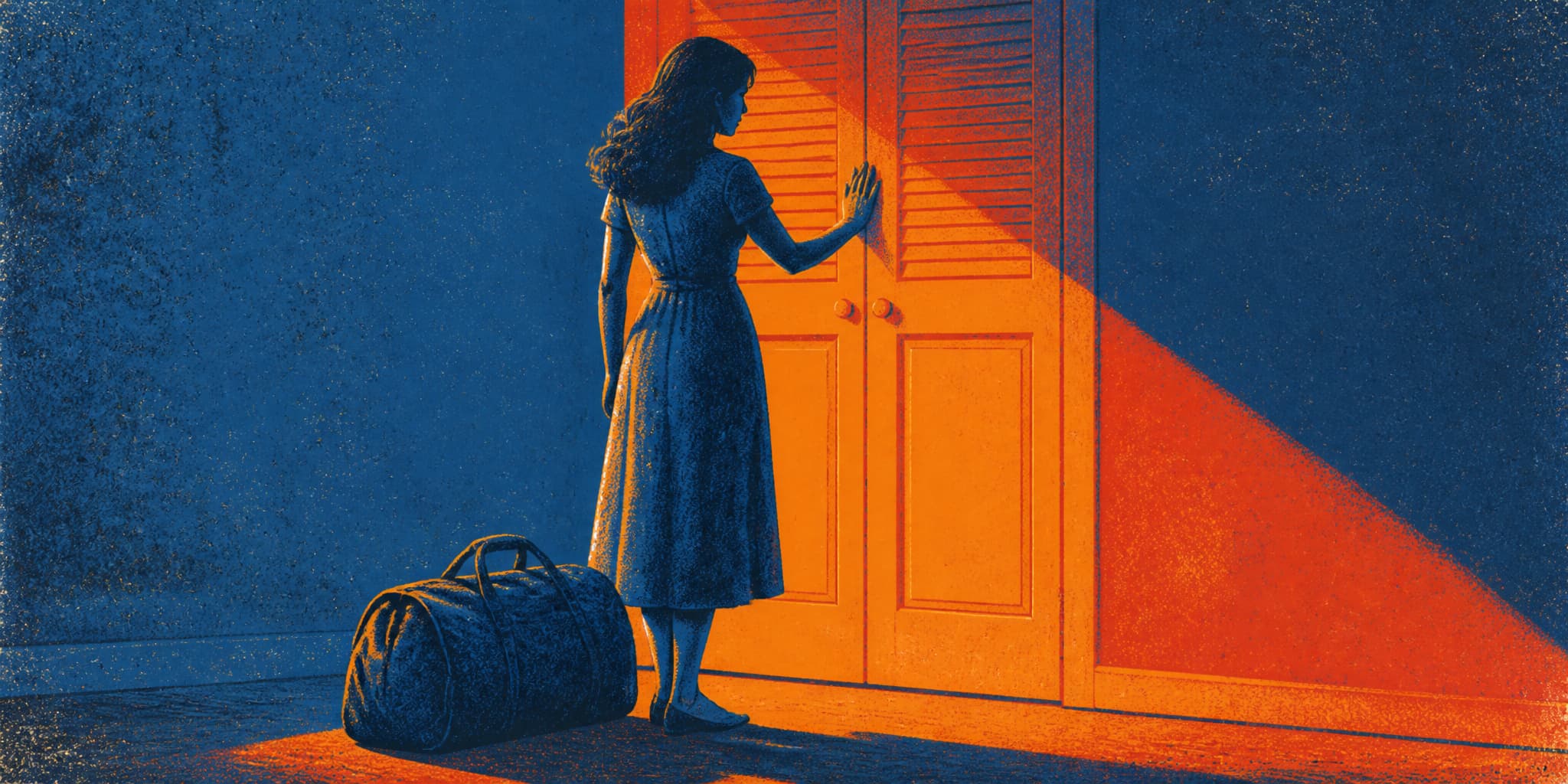
While I cooked, Meg went through the go-bag. Front closet by the door, where you'd grab it on the way out. She unzipped it and checked it the way she'd checked it a hundred times at the rental. Water, first aid, chargers, the documents in their plastic sleeve, cash, medications, masks, the laminated card with the evacuation routes on it. She zipped it and set it back and shut the closet.
She stood there a second with her hand still on the knob. Then she went up to check on Lily.
The zone map was already on the fridge. We'd printed it at the rental and carried it over. Ours was the yellow one. Lily can read it. They teach the levels at school now the way they taught me where to sit in a hallway during a tornado — one means be ready, two means be in the car, three means you're already gone. She knows our route. She knows where we meet if we get separated. She's seven.
We ate at a card table borrowed from Meg's sister, because our table hadn't come yet. Our voices carried. No rugs, no curtains, nothing in the room to take the sound. Lily told us about a book she's reading, a girl and a fox and a mountain, and asked if she could have her tablet after, and I said yes.
After we cleaned up I walked through the house. I wasn't checking anything. I was just walking through it. The vents had fine metal mesh over them, like small window screens, so embers can't get in. The windows were heavy and sealed tight. The attic hatch had a rubber gasket on it, snug as a refrigerator door. There was a panel by the thermostat that showed the indoor air along with the temperature, green numbers sitting in a row. Four inspections. It passed all of them. The re-occupancy notice was in a folder in the kitchen drawer, signed and dated.
Across the street the Hendersons still had their cedar siding and their wood deck and a juniper hedge that wouldn't have cleared anybody's list if they'd had to rebuild. They'd left a note on our door. Welcome back, with an exclamation point and a phone number.
Lily came down in her pajamas. She'd brushed her teeth without being told, which she never does. I think the new bathroom makes her feel like a guest. You're careful in somebody else's house.
"Can I sleep in your room?"
"Sure," Meg said.
I went up and put sheets on the bed. Our window faces west toward the ridge. Same ridge. Mostly the same trees, though the south slope is thinner, the low stuff burned out and not back yet. I looked at that ridge every night for years and I couldn't tell you what I was looking at now.
I opened the window. The air was clean. Pine and dust and a little chemical edge coming off the new house. September. Fire season isn't over in September but the worst of it is usually behind you. Usually.
Lily was asleep in five minutes, between us. She wasn't carrying what we were carrying. I lay there and listened. A new house doesn't sound like anything. The old one settled and ticked and creaked in ways I'd stopped hearing years back. This one just sat there. The refrigerator hummed at a pitch I didn't know.
Around ten the wind shifted.
I felt it before I heard it. The curtain moved. The air through the window came from the south now, warmer and drier, and I was sitting up before I knew I was doing it.
Meg was already awake. She was already looking at me.
Neither of us said anything.
The wind came through the trees and worked around the corners of the house and across the roof. The house didn't move. Vents sealed, siding rated, hundred feet of cleared ground and gravel all the way around. It was built for exactly this.
I got up and closed the window.
Meg picked up her phone. I watched her face in the blue light.
"It's a watch," she said. "Not a warning."
"Okay."
"Supposed to come back around by morning."
She put the phone face down on the nightstand. Lily hadn't moved. She was breathing the way sleeping kids breathe, not interested in the wind.
I lay back down. The ceiling was white and smooth. No stain in the corner, no crack along the seam where the old house had gone uneven over twenty years. I'd memorized that ceiling without meaning to. This one I'd have to learn.
The wind was still out of the south. I could hear it moving over the shingles, steady and dry. The house took it and didn't answer. Just the refrigerator and the wind and Lily breathing between us.
Meg's breathing slowed down, not to sleep but close to it.
I stayed awake. Not because anything needed watching. The alerts were on and everything that was supposed to work had worked and would probably keep working. I just couldn't find the place where you set it down.
The house was fine. It was ours and we were in it. The wind blew and the house held and I figured that was where we were.
-
After fire, "home" measured: California's new Smoke Damage Recovery Act requires insurers to cover testing needed to clear a surviving residence for occupancy, but coverage remains subject to policy dollar limits that can run out before the house is ready.
-
The watch versus warning: The National Weather Service maintains guidance distinguishing Fire Weather Watches from Red Flag Warnings, a difference that determines whether critical fire conditions are possible or already occurring, and that families like this one read in bed at ten o'clock.
-
What rebuilds look like now: Oregon's Wildfire Home Hardening Guide walks through the ember-resistant vents, noncombustible siding, and defensible-space clearances that give new construction in wildfire zones its particular spare appearance.
-
Smoke as cumulative exposure: A 2026 study across twenty states found that each additional unit of wildfire-specific fine particulate matter carried roughly 10 to 16 percent greater hospitalization risk for cardiopulmonary outcomes, larger per-unit associations than non-wildfire PM2.5.