

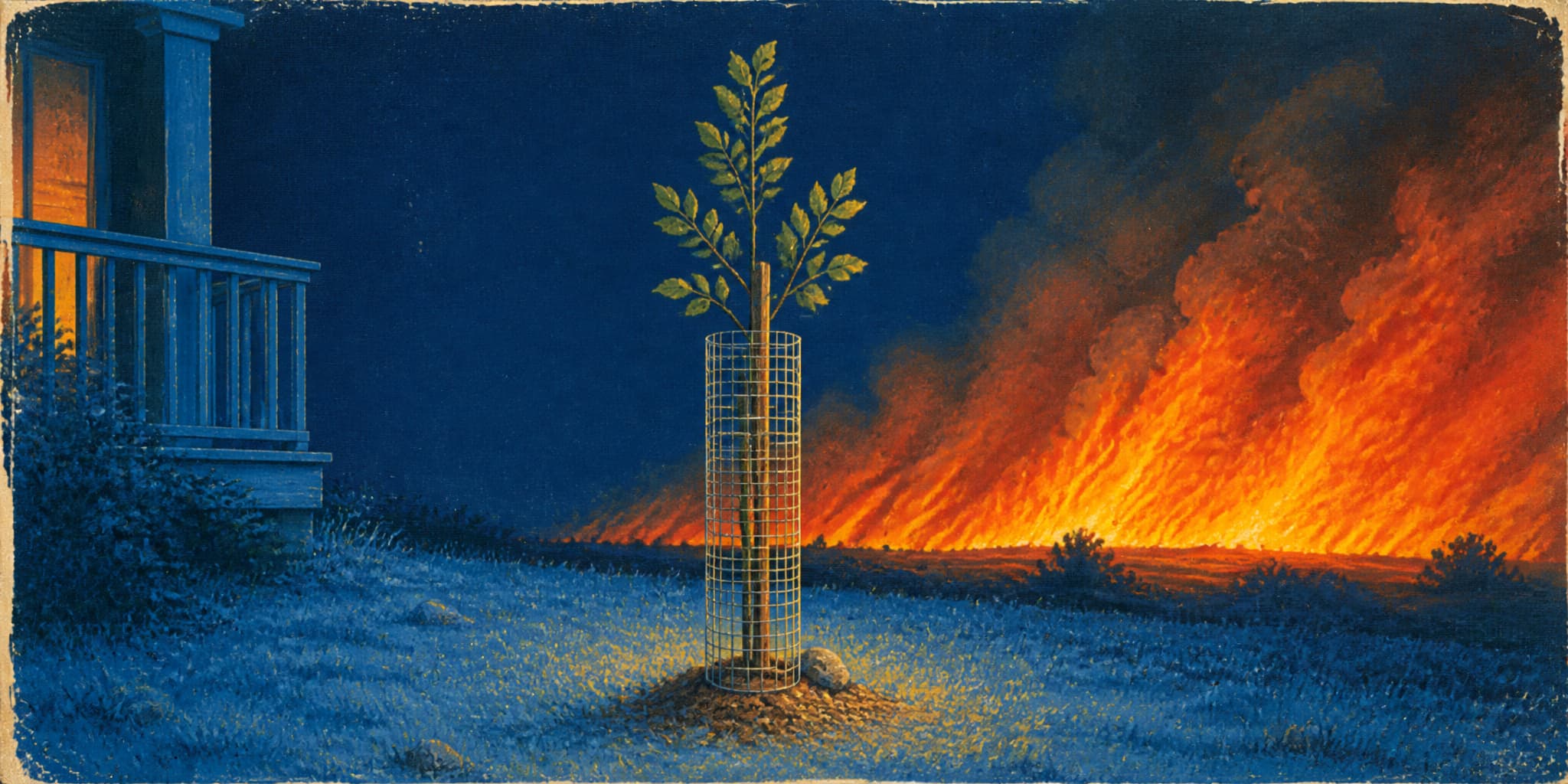
Huntington Acres is a short road in the town of Huntington, Vermont. Several properties on it are now municipally owned through FEMA buyouts. The state's Flood Resilient Communities Fund put over a million dollars into acquisitions at three addresses. The town's 2024 annual report shows 165 Huntington Acres transferring to the town on September 16, 2024. The structures came down. The debris got hauled — a volunteer cleanup pulled about 2.5 tons of it, plus three-quarters of a ton of metal, off seven flood-damaged properties on that road. University of Vermont students staked twenty-five willows and planted fifty trees at one of the acquired sites.
Then, late in 2024, a clean-water project planted trees and shrubs across 1.25 acres of the FEMA-acquired parcels, roughly 300 stems to the acre, laid out as a 150-foot buffer along the river. Budget for implementation was $10,501, including 400 trees. The January 2026 completion report puts the actual cost at $10,051. Somebody got a better price on bare-root stock.
The 2024 grand list shows six other privately owned dwelling parcels on Huntington Acres. Those houses are still standing and still on the tax rolls, alongside the new plantings. Where the neighbors' homes used to be, there are saplings in tubes, staked willows, and deed-restricted open ground that stays undeveloped in perpetuity.
I've watched a few versions of what planners call "managed retreat" — mill towns, port towns, places where the work left and the buildings came down afterward in no particular hurry. It never looks like the phrase sounds. It's a selective subtraction carried out over years, and what it produces is something partway between a neighborhood and a riverbank restoration project. Maya Jiménez walked a version of that landscape in "Betty Doll Pays Two Mortgages," reporting from a North Carolina neighborhood coming apart a lot at a time. Vermont adds a layer. Here the town plants the lots, budgets for their upkeep, folds them into a conservation framework. The acquired land isn't abandoned. It's being handed to the river.
Four hundred trees run about ten thousand dollars. Keeping them alive is a separate line item with a separate funding source and a separate expiration date. The project proposal estimated $5,809 for monitoring and maintenance through 2027, and the funding decision split operations and maintenance off from the implementation award. Anyone who has planted a tree and then tried to keep a deer from eating it will understand the distinction.
The public record contains no first-person account from anybody currently living on Huntington Acres about what it's like beside those planted lots. The people who have spoken — Amy Seoane, who mentioned she'd already lost several neighbors to buyouts before applying for one herself — were on their way out. What the record does establish is the coexistence. Private dwellings and town-owned buffer on the same road. The remaining households pay taxes on property that abuts land the government has decided is too dangerous to live on. Their own houses are, by the logic of the program, viable. Or at least not yet acquired.
The stabilization payments run ten years and stop. The trees, if they make it, don't. Twenty years out, if the buffer matures the way it's drawn, the houses left on Huntington Acres will stand next to a wooded bank thick enough to slow water and hold soil. It won't resemble the road when the road was full of houses. It'll be a handful of homes at the edge of a young forest the river arranged for.
Whether that's a good place to live depends on which version of staying you're doing, and whether you picked it.