

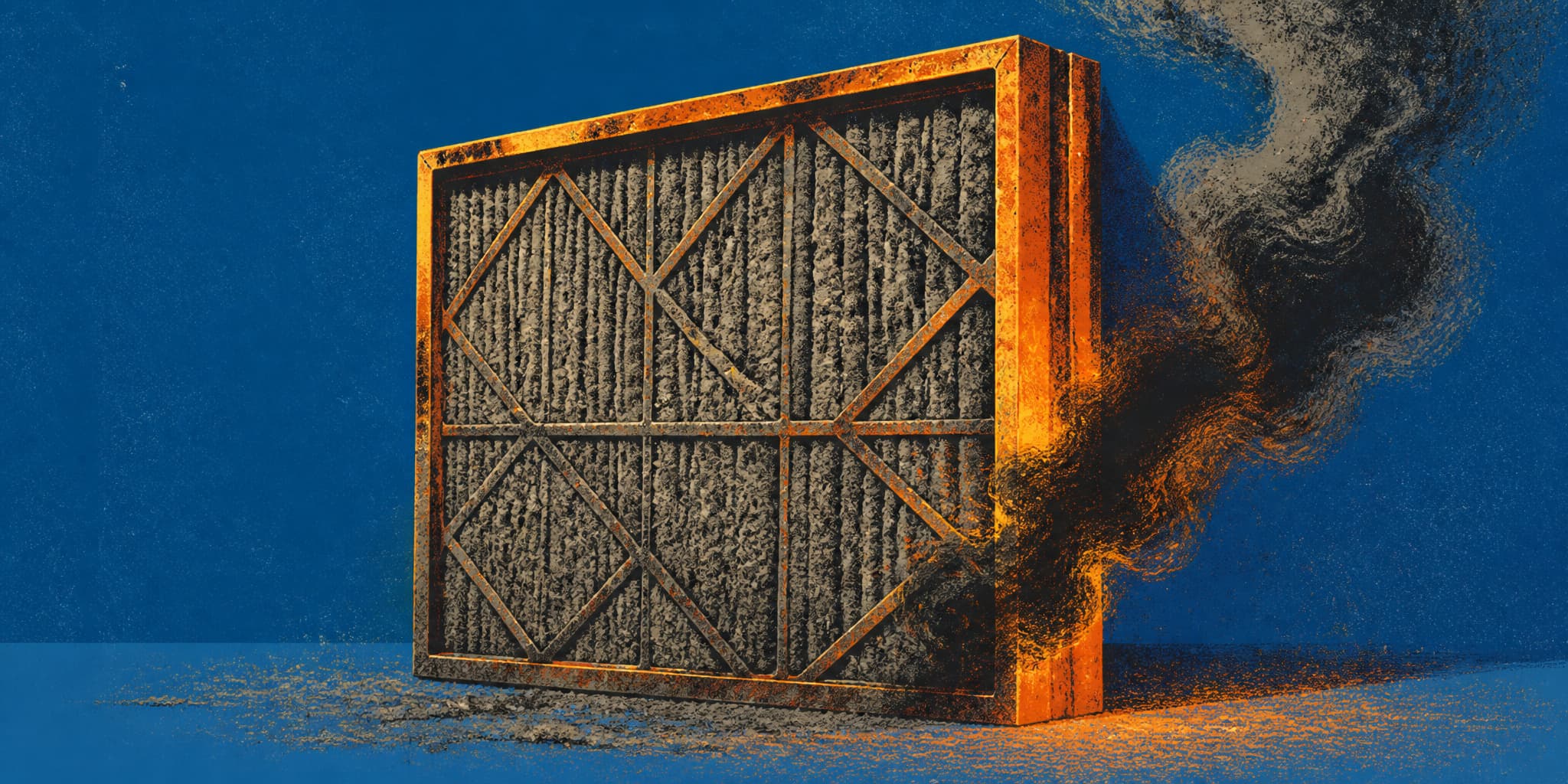
Retrofitting a school as a cooling and clean-air refuge runs into the millions. Federal and state grants cover the hardware. The filters that make it all work cost $25 to $60 apiece, and they come out of the annual maintenance budget, which is a different line item, usually underfunded, on a fiscal calendar that has nothing to do with when the smoke rolls in.
Under heavy wildfire smoke, a MERV 13 filter — the grade the EPA recommends for smoke protection — clogs in two to four weeks instead of the usual three months. A building running multiple HVAC units can exhaust a year's filter budget before August.
The EPA advises facility managers to stockpile before fire season. It does not advise where the money comes from.
When the budget line empties, staff leave loaded filters in place. A clogged MERV 13 restricts airflow badly enough to pull smoke around the filter and into the building. In at least one documented case, deferred filter replacement cost a district eleven times what timely changes would have.]
MERV 13: Filter grade EPA recommends for wildfire smoke. Captures 85–90% of fine particles when clean and properly sealed.
Normal replacement cycle: Every 3–6 months, depending on the system and local air quality.
During smoke events: Inspect every two weeks. Replace 1-inch filters every 2–4 weeks; 4-inch media filters every 2–3 months.
Electrostatic decay: Many MERV 13 filters use charged fibers that lose efficiency faster under sustained smoke loading, accelerating the replacement schedule further.
Fit matters: Gaps around a filter frame let unfiltered air bypass the media entirely, making the rating meaningless.
National scale: GAO estimates 41% of U.S. school districts need HVAC updates in at least half their buildings — roughly 36,000 schools.]